
Gestión térmica en PC industriales sin ventilador: cómo funciona la refrigeración pasiva
Índice de contenidos
How Passive Cooling Works in Fanless PCs
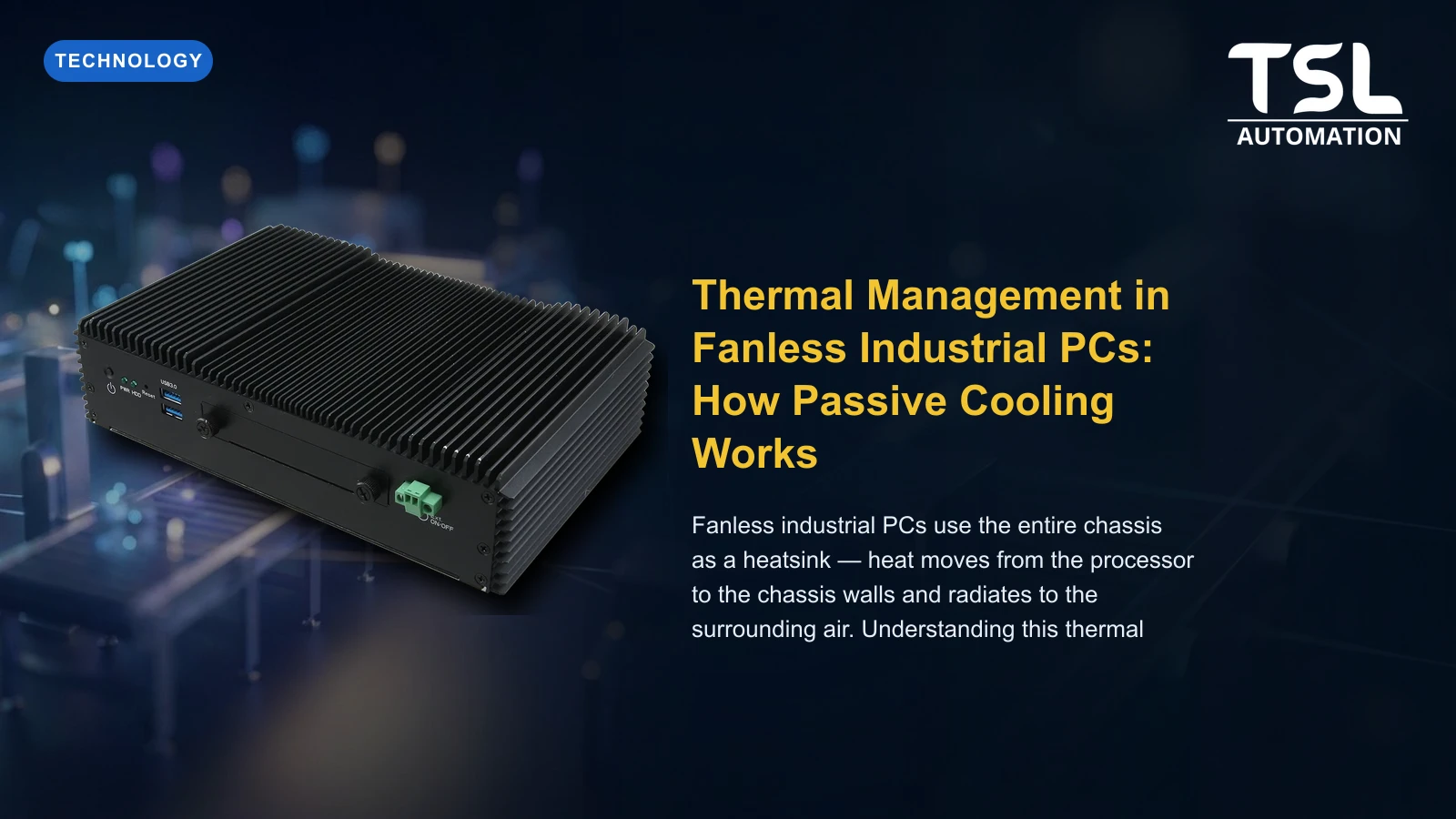
In a fanless industrial PC, processor heat travels through a thermal interface material (TIM) to a copper or aluminium spreader plate, through heat pipes (in some designs) to the chassis walls, and then radiates and convects from the outer surface to the surrounding air. The entire chassis acts as a heatsink, external fins on the top and sides maximise surface area for heat dissipation.
TDP: The Critical Design Limit
Every fanless chassis has a maximum TDP (Thermal Design Power) rating, typically 15W, 25W, 35W, 45W, or 65W. The processor's TDP must not exceed the chassis rating, otherwise the processor will thermally throttle (reduce clock speed to reduce heat output) or, in extreme cases, trigger a thermal shutdown. Always match your processor TDP to the chassis specification.
Effect of Ambient Temperature
Passive cooling efficiency decreases as ambient temperature increases, there is less temperature differential between the chassis surface and the surrounding air. A fanless PC rated to 60°C ambient with a 35W processor may only be rated to 45°C with a 45W processor. Always check the thermal derating curves in the product datasheet.
Installation Best Practices
- Allow airflow around the chassis, do not install directly against a wall or inside a sealed enclosure without ventilation provisions
- Avoid stacking, do not stack multiple fanless PCs without spacing for heat dissipation
- Monitor ambient temperature, if control panel temperatures exceed rated ambient, add forced air cooling to the enclosure (not the PC itself)
- Orient fins correctly, if the chassis has fins, orient them vertically for maximum natural convection
Preguntas frecuentes
TSL Automation Solutions
Directora de Marketing, TSL Automation Solutions
Sanjana escribe sobre tendencias de automatización industrial, lanzamientos de producto y novedades tecnológicas para TSL Automation Solutions, distribuidor con sede en Mumbai de sistemas HMI, Panel PC y computación embebida al servicio de fabricantes de la India y de todo el mundo.
¿Necesita ayuda para elegir el producto adecuado?
Nuestro equipo en Mumbai puede recomendarle el HMI, el Panel PC o el sistema embebido adecuado para su aplicación.
Contactar con TSL AutomationArtículos relacionados

IA en el borde o IA en la nube en la fabricación: latencia, ancho de banda y costes reales
17 ago 2026
NPU, GPU o CPU: ¿qué silicio debe ejecutar su carga de IA en el borde?
17 ago 2026
Subida de los precios de la memoria en 2026: qué supone el alza de la DRAM para el comprador industrial
17 ago 2026