Logo TSL Automation Solutions
Technologia1 min czytania

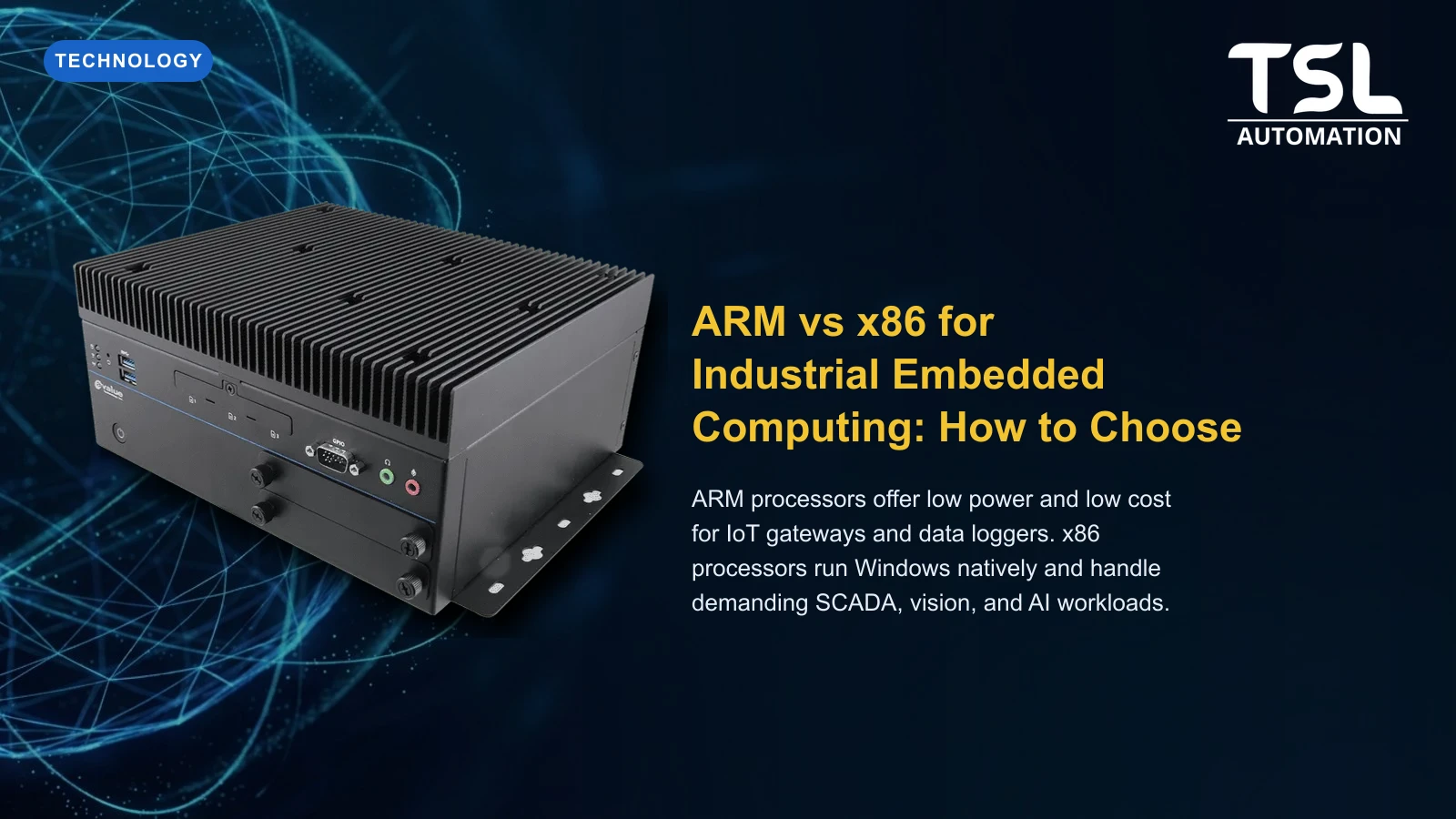
ARM czy x86 w przemysłowych systemach wbudowanych: jak wybrać
TSL Automation Solutions 26 listopada 2024 Zaktualizowano 18 maj 2026
Procesory ARM kontra x86 w przemysłowych komputerach wbudowanych, TSL Automation Solutions
Udostępnij

Spis treści

ARM Architecture

ARM processors are RISC (Reduced Instruction Set Computing) designs licensed by ARM Holdings to chip manufacturers including NXP, Texas Instruments, Qualcomm, and Apple. ARM chips are known for very low power consumption (0.5 do 5W for microcontrollers, 2 do 15W for application processors) and high integration density. Industrial ARM SBCs typically run Linux, they do not natively run Windows.

x86 Architecture

Intel and AMD manufacture x86 CISC processors that run Windows, Linux, and Windows IoT Enterprise. x86 industrial embedded processors range from Intel Atom (6W TDP) for lightweight applications to Intel Core i7 (65W) for demanding workloads. x86 systems are fully compatible with existing Windows-based SCADA, MES, and HMI software without porting.

ARM vs x86 Comparison

FeatureARMx86 (Intel/AMD)
Power consumptionVery low (2 do 10W)Low to high (6 do 125W)
Windows supportLimited (ARM64 Windows)Full Windows/Linux
Industrial softwareLinux-native onlyAll existing Windows SCADA/HMI
CostLowerHigher
PerformanceModerateHigh
EcosystemStrong for IoT/LinuxDominant for industry

Choose ARM When:

  • Building an IoT gateway or data logger on Linux
  • Power and heat are the primary constraints
  • Your application runs open-source software (Node-RED, Python, InfluxDB)

Choose x86 When:

  • Running Windows-based SCADA, MES, or HMI software
  • You need compatibility with existing industrial software
  • Applications require high processing power (vision, AI, SCADA with 1000+ tags)

Często zadawane pytania

ARM processors use a RISC architecture with very low power consumption (0.5 do 15W) and are common in IoT gateways, edge devices, and Linux-based embedded systems. x86 processors (Intel/AMD) use a CISC architecture with higher performance (6 do 125W TDP) and support Windows natively. For industrial automation, x86 is preferred when Windows software, SCADA, or heavy computation is needed; ARM suits lightweight Linux applications, IoT gateways, and battery-powered systems.
Standard ARM embedded processors run Linux (Debian, Ubuntu, Yocto) and Android, not Windows x86 applications. Windows 11 on ARM exists but has limited industrial software compatibility, most SCADA, HMI, and MES software requires x86 Windows. If your application requires Windows-based industrial software, choose an x86 (Intel) embedded PC.
Choose ARM when power consumption is the priority, ARM SBCs typically consume 2 do 8W versus 15 do 65W for x86 industrial PCs. ARM is ideal for IoT gateways running Linux-based data collection, protocol conversion, MQTT/OPC UA publishing, and lightweight AI inference. x86 is better for SCADA workstations, vision systems requiring Windows software, and high-performance data processing.
ARM-based industrial SBCs and embedded computers are generally lower cost than comparable x86 systems, ARM SBCs start from ₹5,000, ₹20,000 for basic gateway applications, while x86 embedded PCs typically start from ₹25,000, ₹80,000. However, when factoring in software licensing (Windows IoT), deployment complexity, and support costs, the total cost of ownership difference narrows for full production systems.
Yes, TSL Automation Solutions supplies Avalue ARM-based panel PCs and embedded systems for lightweight HMI and IoT applications, as well as the full range of Avalue x86 industrial PCs, panel PCs, and embedded computers for Windows-based SCADA and automation. Our team can recommend the right platform for your specific application requirements.
Tagi: ARM vs x86 industrial ARM embedded computer x86 embedded PC ARM vs Intel industrial embedded processor architecture comparison
Przydatne? Prosimy udostępnić
T

TSL Automation Solutions

Dyrektor marketingu, TSL Automation Solutions

Sanjana pisze o trendach w automatyce przemysłowej, premierach produktów i nowych technologiach dla TSL Automation Solutions, dystrybutora paneli HMI, paneli PC i systemów wbudowanych z siedzibą w Mumbaju, obsługującego producentów w Indiach i na całym świecie.

Potrzebna pomoc w wyborze właściwego produktu?

Nasz zespół w Mumbaju doradzi odpowiedni panel HMI, panel PC lub system wbudowany do Państwa zastosowania.

Kontakt z TSL Automation