Logo TSL Automation Solutions
Edukacja1 min czytania

Czym jest EtherNet/IP? Protokół przemysłowego Ethernetu w praktyce
TSL Automation Solutions 18 marca 2025 Zaktualizowano 18 maj 2026
EtherNet/IP, sieć Ethernetu przemysłowego, TSL Automation Solutions
Udostępnij

Spis treści

What Is EtherNet/IP?

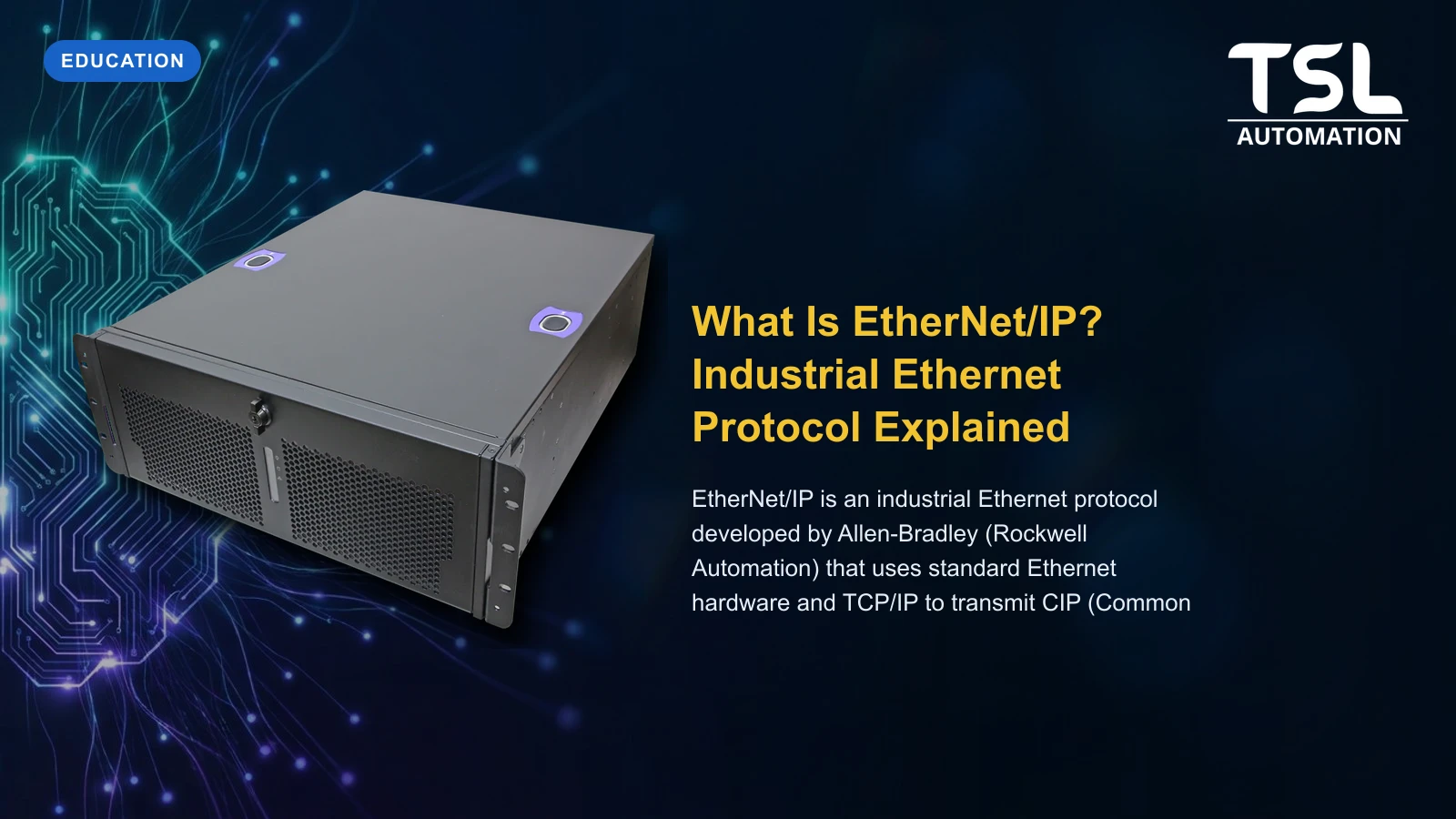
EtherNet/IP (Ethernet Industrial Protocol) is an industrial communication protocol developed by Allen-Bradley (now Rockwell Automation) and managed by ODVA. It uses standard 100 Mbps or 1 Gbps Ethernet hardware and the TCP/IP stack to carry CIP (Common Industrial Protocol) messages, the same application layer used by DeviceNet and ControlNet, over an Ethernet network.

How EtherNet/IP Works

EtherNet/IP uses two communication classes. Explicit Messaging uses TCP/IP for configuration, diagnostics, and non-time-critical data exchange. Implicit Messaging (I/O messaging) uses UDP/IP for real-time, cyclic data exchange between PLCs and field devices, similar to a cyclic I/O scan.

EtherNet/IP vs PROFINET vs Modbus TCP

ProtocolDeveloperPLC Ecosystem
EtherNet/IPRockwell/ODVAAllen-Bradley, Omron
PROFINETSiemens/PISiemens S7, S1500
Modbus TCPModicon/SchneiderUniversal, all vendors

EtherNet/IP and HMI Panels

Many industrial HMI panels, including selected Cermate models, support EtherNet/IP for direct connectivity to Allen-Bradley PLC systems without a protocol converter. Contact TSL Automation to confirm EtherNet/IP driver availability for your specific Cermate HMI model and Allen-Bradley PLC series.

Często zadawane pytania

EtherNet/IP (Ethernet Industrial Protocol) is an industrial Ethernet communication protocol developed by Rockwell Automation and managed by ODVA. It uses standard Ethernet hardware (Cat5e/Cat6 cables and switches) with the CIP (Common Industrial Protocol) application layer for real-time data exchange between PLCs, drives, sensors, and HMI systems, particularly in Allen-Bradley/Rockwell Automation environments.
Both use standard Ethernet hardware, but EtherNet/IP uses the CIP application layer with device profiles and implicit (real-time I/O) messaging, while Modbus TCP is a simpler read/write register protocol. EtherNet/IP provides richer device diagnostics, device profiles, and is natively supported by Allen-Bradley PLCs. Modbus TCP is simpler, universally supported, and easier to implement for basic data collection, but lacks EtherNet/IP's device management capabilities.
EtherNet/IP is native to Allen-Bradley (Rockwell Automation) PLCs, CompactLogix, ControlLogix, MicroLogix 1100/1400. It is also supported by Omron PLCs, Mitsubishi via gateways, and a wide range of drives (Rockwell PowerFlex, SEW MOVI-C), sensors, barcode scanners, and robot controllers from FANUC, ABB, and KUKA. Any device with ODVA EtherNet/IP certification interoperates with Allen-Bradley PLCs.
EtherNet/IP with implicit (I/O) messaging achieves cycle times of 1 do 10ms for real-time data exchange between PLCs and devices, comparable to PROFINET. Explicit messaging (for configuration and diagnostics) is slower (10 do 100ms) but used for non-time-critical data. For servo motion control requiring sub-millisecond synchronisation, EtherCAT is more appropriate than EtherNet/IP.
Cermate HMI panels supplied by TSL Automation Solutions include EtherNet/IP driver support for connecting to Allen-Bradley PLCs. Avalue industrial PCs support EtherNet/IP through SCADA software (Ignition, FactoryTalk) with appropriate drivers. Contact our Mumbai team for EtherNet/IP connectivity requirements.
Tagi: what is EtherNet/IP EtherNet IP protocol industrial Ethernet protocol Allen-Bradley EtherNet/IP EtherNet/IP vs PROFINET Rockwell Automation protocol
Przydatne? Prosimy udostępnić
T

TSL Automation Solutions

Dyrektor marketingu, TSL Automation Solutions

Sanjana pisze o trendach w automatyce przemysłowej, premierach produktów i nowych technologiach dla TSL Automation Solutions, dystrybutora paneli HMI, paneli PC i systemów wbudowanych z siedzibą w Mumbaju, obsługującego producentów w Indiach i na całym świecie.

Potrzebna pomoc w wyborze właściwego produktu?

Nasz zespół w Mumbaju doradzi odpowiedni panel HMI, panel PC lub system wbudowany do Państwa zastosowania.

Kontakt z TSL Automation