Logo TSL Automation Solutions
Edukacja1 min czytania

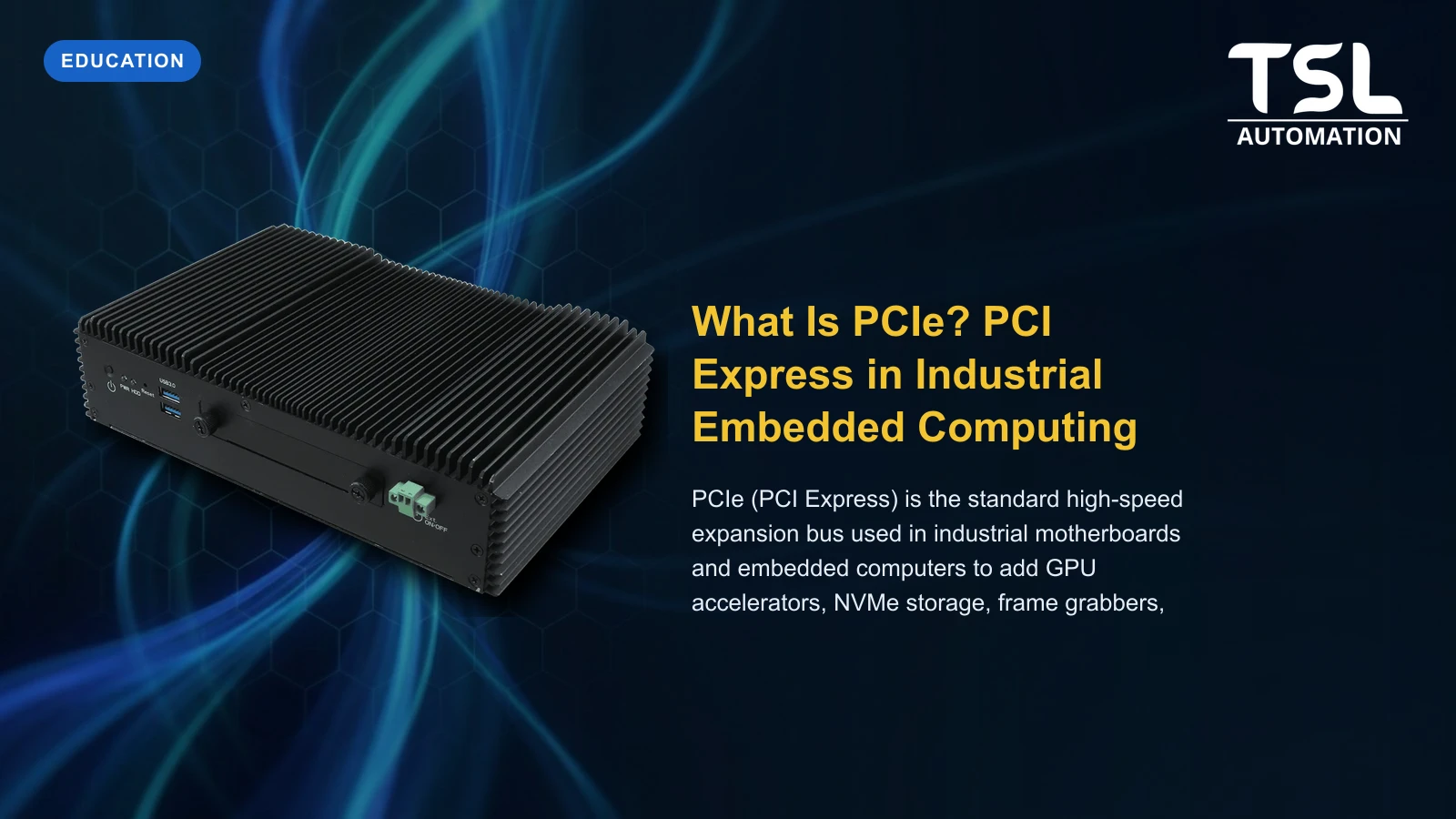
Czym jest PCIe? PCI Express w przemysłowych systemach wbudowanych
TSL Automation Solutions 25 lutego 2025 Zaktualizowano 18 maj 2026
Gniazdo rozszerzeń PCIe na przemysłowej płycie głównej, TSL Automation Solutions
Udostępnij

Spis treści

What Is PCIe?

PCIe (PCI Express) is the standard expansion bus used in modern computers to connect high-speed peripheral devices, GPUs, NVMe SSDs, network cards, and industrial I/O expansion cards, directly to the processor. It replaced the older PCI and AGP buses and is now universal across industrial motherboards, workstations, and embedded computers.

PCIe Lanes and Generations

PCIe bandwidth scales with the number of lanes (×1, ×4, ×8, ×16) and the generation:

GenerationSpeed per Lane×16 Bandwidth
PCIe 3.01 GB/s16 GB/s
PCIe 4.02 GB/s32 GB/s
PCIe 5.04 GB/s64 GB/s

PCIe in Industrial Embedded Computing

Industrial applications for PCIe expansion include:

  • Machine vision, PCIe frame grabber cards for camera interfaces (Camera Link, CoaXPress)
  • AI inference, PCIe GPU cards (NVIDIA RTX, Intel ARC) for edge AI workloads
  • High-speed storage, NVMe SSDs over PCIe ×4 for data-intensive applications
  • Industrial I/O, PCIe cards adding serial ports, digital I/O, or motion control interfaces
  • Networking, multi-port GbE or 10GbE cards for network-intensive SCADA or vision systems

Avalue's ATX and EATX industrial motherboards support PCIe 4.0 and 5.0 expansion, contact TSL Automation to identify the right board for your expansion requirements.

Często zadawane pytania

PCIe (PCI Express) is the standard high-speed expansion bus used in modern industrial computers to connect peripheral devices, GPUs for AI inference, NVMe SSDs for fast data storage, industrial I/O cards, and network adapters, directly to the processor. It replaced legacy PCI and ISA buses and is now universal on industrial motherboards, Box PCs, and embedded workstations.
PCIe slot width (x1, x4, x8, x16) indicates the number of data lanes. Each PCIe 3.0 lane provides approximately 1 GB/s bandwidth; an x16 slot provides up to 16 GB/s, sufficient for a high-performance GPU or NVMe RAID. x1 slots suit network cards and serial I/O cards; x4 suits NVMe SSDs; x16 suits GPUs and AI accelerator cards. Physically shorter cards can be installed in longer slots.
Common PCIe expansion cards in industrial PCs include: NVIDIA GPU cards for AI and vision inference; frame grabber cards for industrial cameras; multi-port Gigabit or 10GbE network cards for OT network isolation; serial communication cards for legacy PLC connectivity; NVMe SSD expansion cards; and industrial fieldbus cards (PROFIBUS, EtherCAT, DeviceNet).
Compact fanless industrial Box PCs typically have one PCIe x4 or x16 slot for a single expansion card. Mid-range systems offer 2 to 3 PCIe slots. Full ATX industrial workstations can accommodate 4 to 7 PCIe slots for multiple GPU, I/O, and network cards simultaneously. The number of available PCIe lanes is limited by the CPU and chipset, high lane count requires Xeon or Core i7/i9 processors with enterprise chipsets.
Yes, Avalue industrial Box PCs and motherboards include PCIe expansion slots ranging from x1 to x16, depending on the platform. Compact fanless units typically include one PCIe x16 slot for GPU or AI accelerator cards. Avalue ATX industrial motherboards support multiple PCIe slots for multi-card configurations. TSL Automation Solutions can advise on the right Avalue platform for your expansion requirements.
Tagi: what is PCIe PCI Express industrial PCIe expansion embedded PCIe slot industrial PC PCIe vs PCI industrial PCIe GPU industrial
Przydatne? Prosimy udostępnić
T

TSL Automation Solutions

Dyrektor marketingu, TSL Automation Solutions

Sanjana pisze o trendach w automatyce przemysłowej, premierach produktów i nowych technologiach dla TSL Automation Solutions, dystrybutora paneli HMI, paneli PC i systemów wbudowanych z siedzibą w Mumbaju, obsługującego producentów w Indiach i na całym świecie.

Potrzebna pomoc w wyborze właściwego produktu?

Nasz zespół w Mumbaju doradzi odpowiedni panel HMI, panel PC lub system wbudowany do Państwa zastosowania.

Kontakt z TSL Automation