

Karta katalogowa produktu
14 September 2026
Przemysłowa i wbudowana płyta główna · ARM-based-SBC
RSC-3576J
Seria: RSC
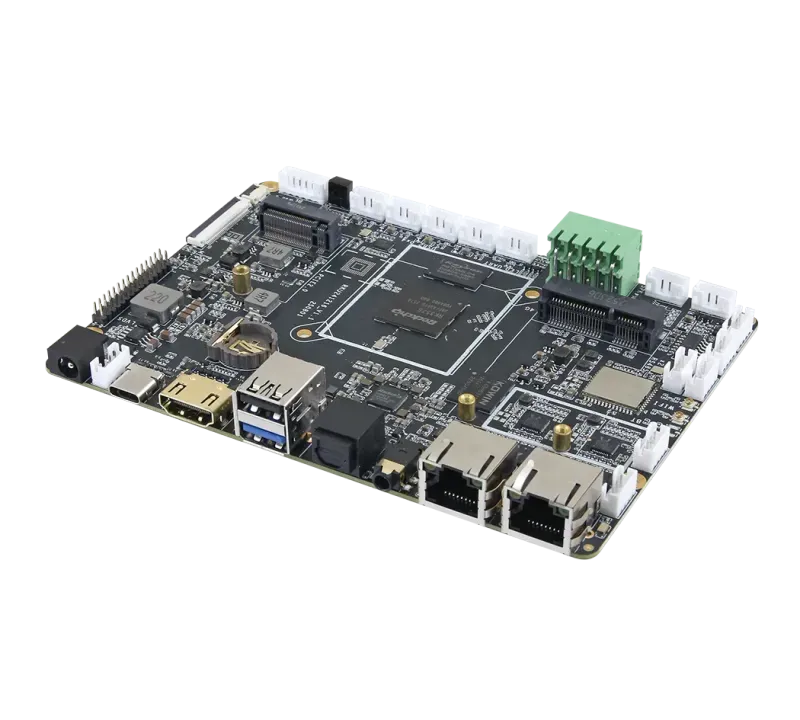
The Avalue RSC-3576J is an ARM-based single board computer (SBC) built on the Rockchip RK3576 processor, pairing a quad-core Cortex-A72 with a quad-core Cortex-A53 for balanced performance and power efficiency in embedded and edge applications. It ships with 4GB LPDDR4 memory (expandable to 8GB or 16GB) and 64GB onboard eMMC storage (configurable from 32GB up to 256GB), with an additional M.2 Key-M slot for an NVMe/SATA M.2 SSD. The board supports dual independent display through one HDMI output plus an LVDS or MIPI-DSI panel interface, making it well suited to HMI, kiosk, and industrial display front-ends. Connectivity is extensive for an SBC of this class: dual 10/100/1000M Gigabit Ethernet, USB 3.0 Type-A, USB 2.0 Type-A and a USB 3.0 Type-C (OTG) port, multiple RS-232/RS-485 serial channels, CAN bus, GPIO via phoenix terminals, UART and I2C headers, plus optional 802.11ax Wi-Fi with Bluetooth 5.0 and an optional Mini-PCIe LTE module (EC25-EUX). With a wide DC 12~24V input and a -40°C to 85°C operating temperature range, the RSC-3576J is engineered for reliable deployment in demanding industrial automation, edge AI, IoT gateway, and machine-control environments running Linux Debian or Android 13.
Najważniejsze cechy
- Rockchip RK3576 Processor (Quad-core Cortex-A72 + Quad-core Cortex-A53)
- 4GB LPDDR4 Onboard Memory (8GB / 16GB Optional)
- 64GB eMMC Storage (32GB ~ 256GB Optional) + M.2 Key-M SSD Slot
- Dual Independent Display: 1 x HDMI + LVDS or MIPI-DSI
- Dual 10/100/1000M Gigabit Ethernet
- USB 3.0 / USB 2.0 / USB 3.0 Type-C (OTG), RS-232, RS-485, CAN Bus, GPIO
- Optional 802.11ax Wi-Fi + Bluetooth 5.0; Optional Mini-PCIe LTE (EC25-EUX)
- Wide DC 12 ~ 24V Input
- Wide Operating Temperature -40°C ~ 85°C
- Linux Debian and Android 13 OS Support
Dane techniczne
Informacje o systemie
| Procesor | Rockchip RK3576 Quad-core Cortex-A72 and Quad-core Cortex-A53 |
|---|---|
| Pamięć systemowa | 4GB LPDDR4 (8GB / 16GB Optional) |
Pamięć masowa
| Pamięć masowa | 64 GB eMMC (32GB ~ 256GB Optional) |
|---|
Rozszerzenia
| Rozszerzenia | 1 x Mini PCIe (LTE Module / EC25-EUX) (option), 1 x M.2 Key-M connector (M.2 SSD) |
|---|
Wyświetlacz
| Wiele wyświetlaczy | Dual Display - 1 x HDMI out + LVDS or MIPI display |
|---|---|
| LVDS | 1 x (2x15 pin), 2.0mm (J5301), LCD Backlight Brightness 1 x 6pin, 2.0mm |
| Cyfrowy interfejs wyświetlacza | MIPI DSI FPC 1 x 40P, 0.5mm (J5000) |
Audio
| Kodek audio | Headphone 1 x 3.5mm Jack, 1 x 4 pin, 2.0mm |
|---|---|
| Wyjście głośnikowe | 1 x 4 pin, 2.0mm (J7001) |
Ethernet
| Interfejs Ethernet | 2 x 100M/1000M Ethernet |
|---|---|
| Chipset LAN | RTL8211FI-CG QFN40 |
| Port LAN | RJ45 |
Zewnętrzne I/O
| USB | 1 x USB 3.0 Type A, 1 x USB 2.0 Type A, 1 x USB 3.0 Type C (OTG) |
|---|
I/O
| UART | 1 x 4 pin, 2.0mm (J9800) |
|---|---|
| GPIO | 2 x 10P, 3.81mm phoenix terminal (J9500) |
| Port szeregowy | 2 x RS-232 4pin, 2.0mm, 2 x RS-485 4pin, 2.0mm |
| Magistrala CAN | 1 x 4pin, 3.81mm |
| Łączność bezprzewodowa | WiFi 2T2R 802.11 ax/ac/a/b/g/n (1 x IPEX) (option), Bluetooth 5.0 |
| I2C | 1 x FPC 0.5mm |
Wymagania dotyczące zasilania
| Wejście DC | DC 12 ~ 24V |
|---|
Wsparcie programowe
| Informacje o systemie operacyjnym | Linux Debian, Android 13 |
|---|
Certyfikaty
| Informacje o certyfikacji | CE, FCC Class B |
|---|
Parametry mechaniczne i środowiskowe
| Temperatura pracy | -40°C ~ 85°C |
|---|