Che cos'è un fieldbus? Le reti di comunicazione industriale spiegate
Indice dei contenuti
What Is a Fieldbus?
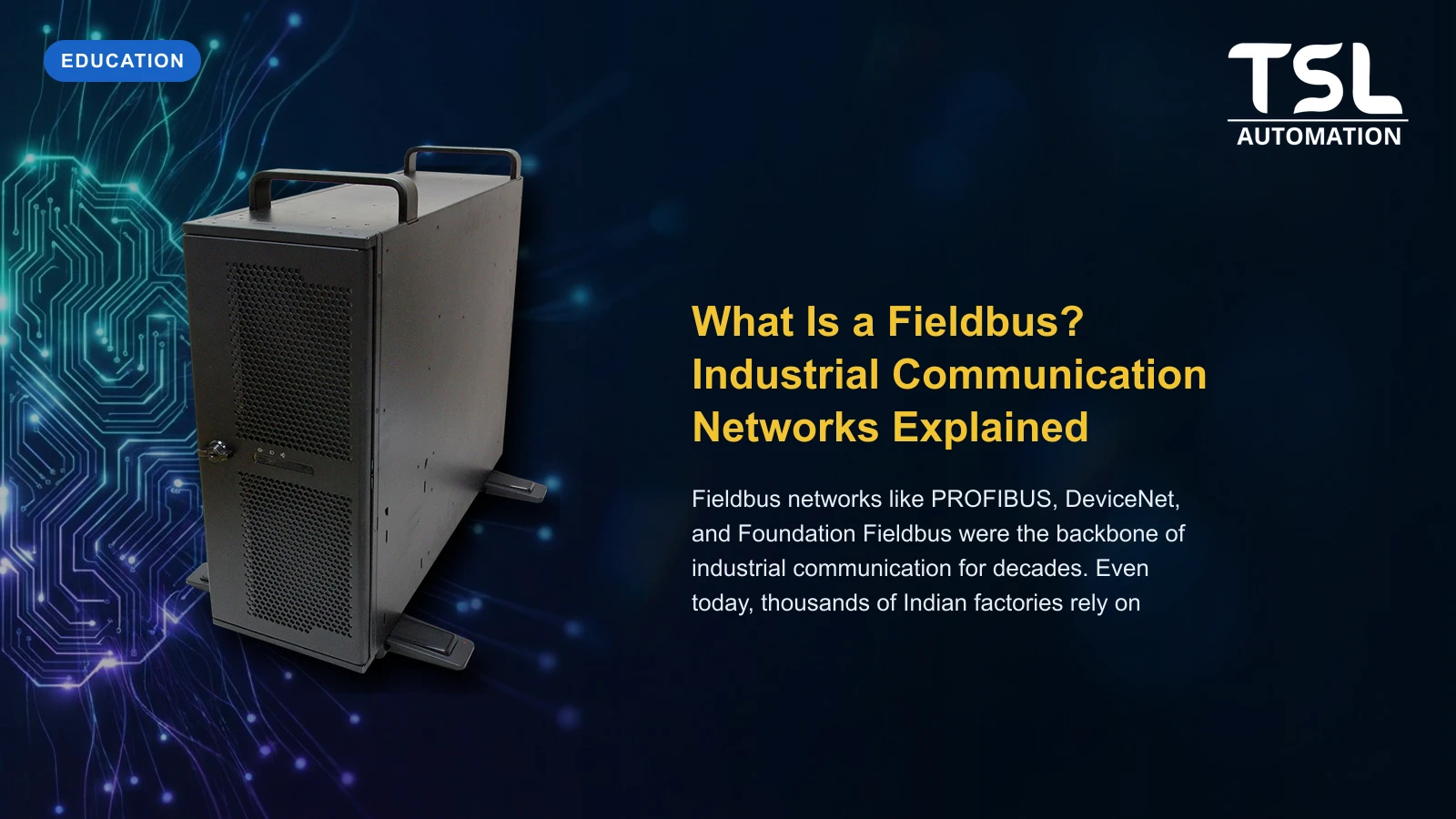
A fieldbus is a digital, serial, two-way communication network that connects field-level devices, sensors, actuators, PLCs, drives, and instruments, to a control system. Before fieldbuses, every field device required a dedicated 4 a 20 mA analogue cable back to the controller. Fieldbuses replaced those point-to-point analogue wires with a single shared digital cable, dramatically reducing wiring cost and complexity.
The term "fieldbus" covers a family of different standards developed from the 1980s onwards. The major fieldbuses used in Indian industry today include PROFIBUS, DeviceNet, and Foundation Fieldbus.
The Major Fieldbus Protocols
PROFIBUS
PROFIBUS (Process Field Bus) is the most widely deployed fieldbus in the world, developed in Germany in the late 1980s. It comes in two variants:
- PROFIBUS DP (Decentralised Periphery), used for fast, cyclic communication between PLCs and field devices such as drives, I/O modules, and encoders. Speeds up to 12 Mbit/s over RS-485 cable.
- PROFIBUS PA (Process Automation), intrinsically safe variant for hazardous areas (process industries), operates at 31.25 kbit/s over a two-wire bus that also powers field instruments.
DeviceNet
DeviceNet was developed by Allen-Bradley (Rockwell Automation) and is widely used in North American and Indian automotive plants. It is based on the CAN (Controller Area Network) protocol, operates at up to 500 kbit/s, and supports up to 64 nodes on a single network segment. DeviceNet is commonly found connecting motor starters, photoelectric sensors, and I/O blocks to Rockwell PLCs.
Foundation Fieldbus (FF)
Foundation Fieldbus is an all-digital, bidirectional communication standard developed for process automation, oil refineries, chemical plants, and power generation. Unlike PROFIBUS, Foundation Fieldbus devices can execute control functions locally at the device level, reducing the load on the central controller. It operates at 31.25 kbit/s (H1) at the field level and 100 Mbit/s (HSE) at the control network level.
Fieldbus vs Industrial Ethernet: Key Differences
| Feature | Fieldbus (PROFIBUS/DeviceNet) | Industrial Ethernet (PROFINET/EtherNet/IP) |
|---|---|---|
| Speed | Up to 12 Mbit/s | 100 Mbit/s to 1 Gbit/s |
| Cable | Dedicated fieldbus cable | Standard CAT5e/CAT6 |
| Topology | Bus / daisy-chain | Star, ring, line |
| Determinism | Deterministic | Deterministic (with managed switches) |
| IT integration | Requires gateway | Native TCP/IP integration |
| Legacy support | Huge installed base | Growing rapidly |
| Cost | Higher per-device cost | Lower hardware cost |
Why Fieldbuses Are Still Used
Despite the rise of Industrial Ethernet, fieldbuses remain dominant in many Indian factories for several practical reasons:
- Installed base, millions of PROFIBUS and DeviceNet devices are already deployed and working. Replacing them is expensive and disruptive.
- Proven reliability, PROFIBUS DP has a 30-year track record of reliable operation in harsh industrial environments.
- Intrinsic safety, PROFIBUS PA and Foundation Fieldbus H1 are certified for hazardous area use in oil, gas, and chemical plants.
- Simple diagnostics, experienced maintenance teams understand fieldbus diagnostics well.
Bridging Fieldbus to Modern Systems
The practical challenge today is connecting legacy fieldbus systems to modern SCADA, MES, and cloud platforms. This is done via protocol gateways, dedicated hardware that translates PROFIBUS or DeviceNet data into Modbus TCP, OPC UA, or MQTT for onward transmission.
Cermate HMI panels from TSL Automation Solutions support PROFIBUS DP as a built-in protocol driver, allowing direct connection to existing PROFIBUS networks without additional gateways. Avalue industrial PCs can run OPC server software to bridge fieldbus data to higher-level systems. Contact TSL Automation Solutions to discuss your fieldbus integration requirements.
Domande frequenti
TSL Automation Solutions
Responsabile marketing, TSL Automation Solutions
Sanjana si occupa di tendenze dell'automazione industriale, lanci di prodotto e approfondimenti tecnologici per TSL Automation Solutions, distributore con sede a Mumbai di HMI, Panel PC e sistemi di computing embedded al servizio dei produttori in India e nel mondo.
Ha bisogno di aiuto per scegliere il prodotto giusto?
Il nostro team di Mumbai può consigliarle l'HMI, il Panel PC o il sistema embedded giusto per la sua applicazione.
Contatti TSL Automation