
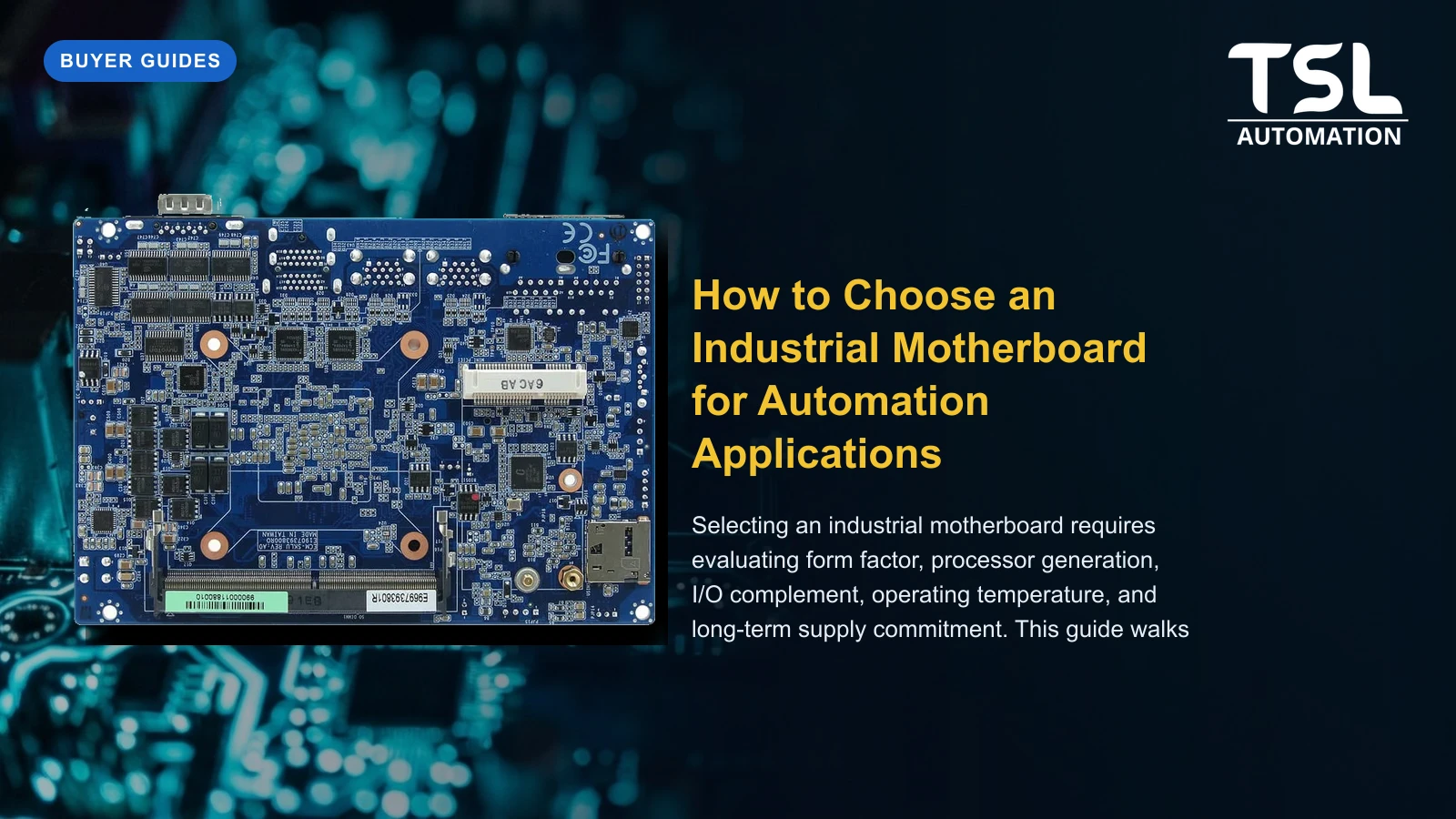
Jak wybrać przemysłową płytę główną do zastosowań w automatyce
Spis treści
Step 1: Choose the Form Factor
- ATX (305×244mm), full-size; maximum expansion slots; for demanding SCADA servers and vision systems
- Micro-ATX (244×244mm), mid-size; good balance of expansion and space
- Mini-ITX (170×170mm), compact; ideal for Panel PCs and embedded Box PCs
- Thin Mini-ITX, ultra-slim profile; designed for Panel PC integration
- 3.5" SBC, very compact; for IoT gateways and space-constrained installations
Step 2: Processor Generation and TDP
For fanless systems, stay within the chassis TDP rating. Intel Core Ultra and Core i5/i7 12th, 14th Gen offer excellent performance-per-watt for industrial applications. Avoid end-of-life processors (7th Gen and older) for new designs, spare parts and driver support become difficult.
Step 3: Required I/O
List your physical I/O requirements before selecting a board:
- Number of COM ports (RS-232/422/485) needed for PLCs and serial devices
- Dual LAN for OT/IT network separation
- Display outputs (HDMI, DP, LVDS, eDP) for your screen configuration
- USB ports for operator peripherals and USB keys
- GPIO for digital I/O to field devices
Step 4: Long-Term Availability
This is the most critical factor for industrial applications. Consumer motherboards are discontinued in 12 do 18 months. Industrial motherboards from Avalue carry 5 do 7 year availability commitments, with extended support agreements available. Always confirm the product lifecycle before committing to a design.
Step 5: Operating Temperature
Standard: 0°C, 60°C. Extended: −20°C, 70°C. Wide: −40°C, 85°C. Match the board's rated temperature to your installation environment, including worst-case seasonal temperatures for your facility.
Często zadawane pytania
TSL Automation Solutions
Dyrektor marketingu, TSL Automation Solutions
Sanjana pisze o trendach w automatyce przemysłowej, premierach produktów i nowych technologiach dla TSL Automation Solutions, dystrybutora paneli HMI, paneli PC i systemów wbudowanych z siedzibą w Mumbaju, obsługującego producentów w Indiach i na całym świecie.
Potrzebna pomoc w wyborze właściwego produktu?
Nasz zespół w Mumbaju doradzi odpowiedni panel HMI, panel PC lub system wbudowany do Państwa zastosowania.
Kontakt z TSL AutomationPowiązane artykuły
Jak wybrać serwer brzegowy AI: poradnik zakupowy dla AI & wizji maszynowej
4 sie 2026
Panel PC z Androidem czy z Windows do kiosków samoobsługowych i QSR?
20 maj 2026
COM Express, SMARC czy Qseven? Który standard Computer-on-Module (COM) wybrać
20 maj 2026