
Avalue · Computación de alto rendimiento
HPM-SRSDE
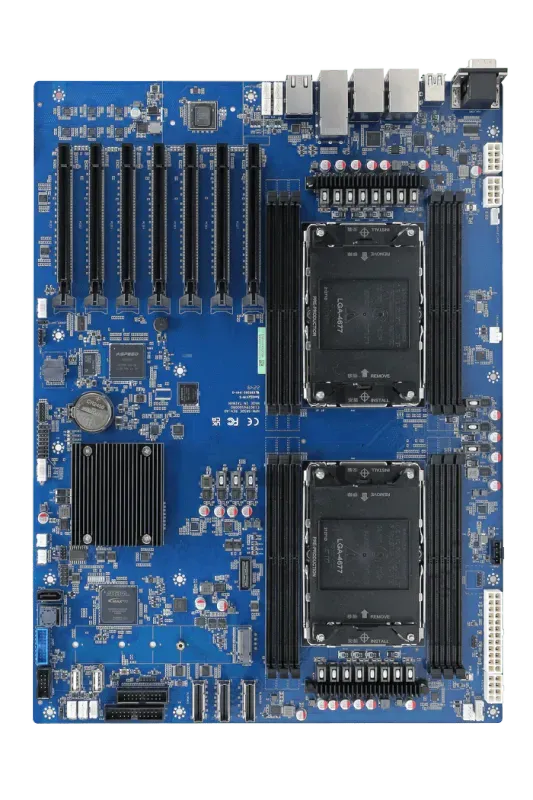
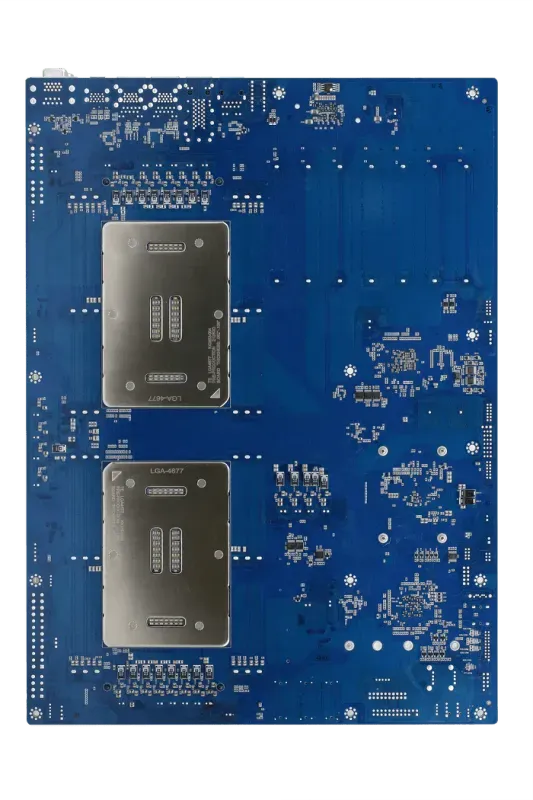
*Precio bajo consulta. Contáctenos para obtener un presupuesto.
Aspectos destacados
- Dual 4th Gen Intel® Xeon® Scalable proprietary server board with IPMI 2.0
- 2 x Intel LGA4677 sockets (max. TDP 270W each), Intel® C741 chipset
- 12 x DDR5 4800/4400MHz RDIMM up to 3TB
- TPM 2.0 onboard; IPMI 2.0 with AST2600 BMC controller
- Intel I210AT 1GbE + I226-LM 2.5GbE + X550AT2 (2 x 10GbE)
- 7 x PCIe Gen5 x16 slots
- 1 x M.2 M-Key PCIe 5.0 x4 NVMe (2242/2260/2280/22110)
- 5 x SATA III (RAID 0/1/5/10) + 3 x Slim SAS 8i
- 12" x 16.452" (304.8 x 417.88 mm); Windows 10 IoT / Server IoT / Ubuntu / RHEL
Descripción del producto
The Avalue HPM-SRSDE is a dual-socket proprietary-form-factor server board built on twin Intel LGA4677 sockets for 4th Generation Intel® Xeon® Scalable processors (max.
TDP up to 270W each) with the Intel® C741 chipset, designed as a high-core-count, expansion-rich x86 platform for HPC and edge data-center nodes.
With 12 x DDR5 4800/4400MHz RDIMM up to 3TB, onboard TPM 2.0 and IPMI 2.0 via an ASPEED AST2600 BMC, it delivers two-socket Xeon Scalable performance on a 12" x 16.452" board.
It provides 7 x PCIe Gen5 x16 slots, an M.2 M-Key PCIe 5.0 x4 NVMe, 5 x SATA III (RAID 0/1/5/10), 3 x Slim SAS 8i, triple Intel Ethernet (I210AT 1GbE, I226-LM 2.5GbE, X550AT2 dual 10GbE), and USB 3.2 Gen1/USB 2.0, running Windows 10 IoT / Windows Server IoT 2019/2022, Ubuntu or RHEL.
Especificaciones técnicas
¿Qué es HPM-SRSDE?
The HPM-SRSDE is a computación de alto rendimiento manufactured by Avalue, designed specifically for server-board applications. It features red of 1 x Intel I210AT 1GbE controller, 1 x Intel I226-LM 2.5GbE controller, 1 x Intel X550AT2 10GbE controller s… and so of AMI UEFI BIOS. The Avalue HPM-SRSDE is a dual-socket proprietary-form-factor server board built on twin Intel LGA4677 sockets for 4th Generation Intel® Xeon® Scalable processors (max. TDP up to 270W each) with the Intel® C741 chipset, designed as a high-core-count, expansion-rich x86 platform for HPC and edge data-center nodes. With 12 x DDR5 4800/4400MHz RDIMM up to 3TB, onboard TPM 2.0 and IPMI 2.0 via an ASPEED AST2600 BMC, it delivers two-socket Xeon Scalable performance on a 12" x 16.452" board. It provides 7 x PCIe Gen5 x16 slots, an M.2 M-Key PCIe 5.0 x4 NVMe, 5 x SATA III (RAID 0/1/5/10), 3 x Slim SAS 8i, triple Intel Ethernet (I210AT 1GbE, I226-LM 2.5GbE, X550AT2 dual 10GbE), and USB 3.2 Gen1/USB 2.0, running Windows 10 IoT / Windows Server IoT 2019/2022, Ubuntu or RHEL.
Características y ventajas principales
- Dual 4th Gen Intel® Xeon® Scalable proprietary server board with IPMI 2.0
- 2 x Intel LGA4677 sockets (max. TDP 270W each), Intel® C741 chipset
- 12 x DDR5 4800/4400MHz RDIMM up to 3TB
- TPM 2.0 onboard; IPMI 2.0 with AST2600 BMC controller
- Intel I210AT 1GbE + I226-LM 2.5GbE + X550AT2 (2 x 10GbE)
- 7 x PCIe Gen5 x16 slots
- 1 x M.2 M-Key PCIe 5.0 x4 NVMe (2242/2260/2280/22110)
- 5 x SATA III (RAID 0/1/5/10) + 3 x Slim SAS 8i
- 12" x 16.452" (304.8 x 417.88 mm); Windows 10 IoT / Server IoT / Ubuntu / RHEL
Aplicaciones y casos de uso
El HPM-SRSDE es ideal para numerosas aplicaciones de automatización industrial:
- High-performance computing and data processing tasks
- Memory-intensive applications and multitasking
- Internet of Things (IoT) and edge computing
- Industrial computing and data processing
- Edge computing and IoT applications
- Real-time monitoring and control
- Industrial automation systems