
Technologie1 min de lecture
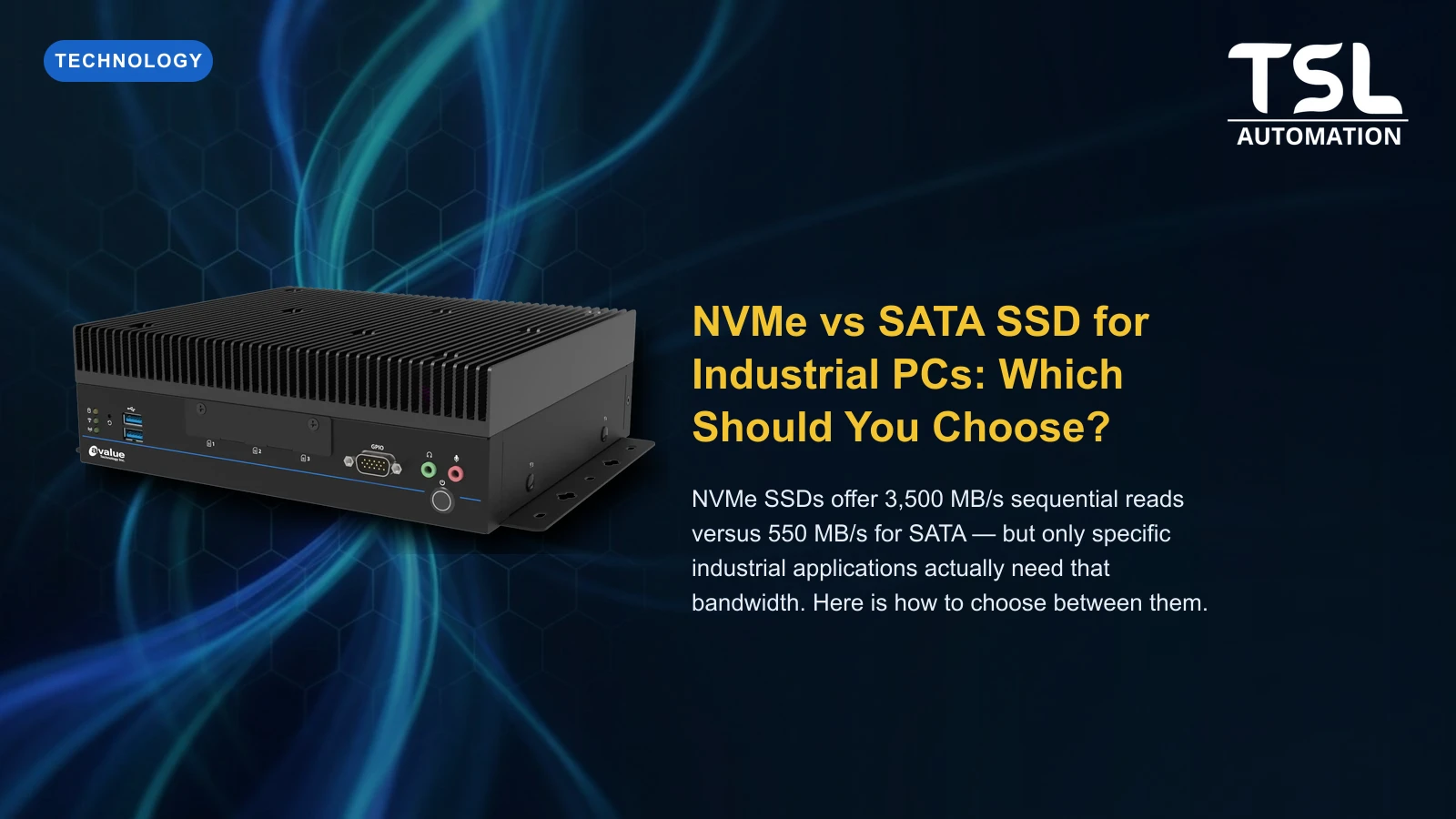
SSD NVMe ou SATA pour PC industriels : lequel choisir ?
TSL Automation Solutions 2 juillet 2024 Mis à jour le 18 mai 2026
Partager
Sommaire
NVMe vs SATA: Performance Comparison
| Metric | SATA SSD | NVMe (PCIe 3.0) | NVMe (PCIe 4.0) |
|---|---|---|---|
| Sequential Read | 550 MB/s | 3,500 MB/s | 7,000 MB/s |
| Sequential Write | 520 MB/s | 3,200 MB/s | 6,500 MB/s |
| Interface | SATA III | M.2 PCIe | M.2 PCIe |
| Boot time (Windows) | ~25 seconds | ~10 seconds | ~8 seconds |
When NVMe Speed Matters for Industrial Applications
- Machine vision, archiving high-resolution images at production-line rates (100+ images/second)
- AI inference, loading large model weights at startup; streaming training data
- High-frequency data logging, historian applications writing thousands of tags per second
- Video surveillance, simultaneous recording from multiple high-resolution cameras
When SATA Is Sufficient
- SCADA workstations with standard tag counts (<5,000 tags)
- HMI operator panels
- IoT gateways and data loggers with low write rates
- Any application where storage is not the performance bottleneck
Industrial SSD Grades
Not all SSDs are suitable for industrial deployment. Consumer SSDs are not rated for 24/7 write workloads (they use TLC NAND optimised for light consumer use). Industrial SSDs use SLC or pSLC NAND with:
- Higher endurance (3,000 à 100,000 P/E cycles vs 1,000 for consumer TLC)
- Power loss protection (capacitor holds writes during power failure)
- Wide temperature operation (−40°C to 85°C)
- Vibration resistance (MIL-STD-810 tested)
Questions fréquentes
NVMe SSDs connect via PCIe and achieve sequential read speeds of 3,000 à 7,000 MB/s. SATA SSDs are limited to 550 MB/s by the SATA interface. For industrial PCs, NVMe significantly reduces OS boot time, application load time, and database query response. SATA remains acceptable for basic data logging and HMI applications; NVMe is preferred for SCADA servers, machine vision systems, and AI inference where large data volumes are read continuously.
Always use industrial-grade SSDs in production industrial PCs. Industrial SSDs include power-loss protection (a capacitor that flushes the write cache to NAND on sudden power loss, preventing filesystem corruption), wide temperature ratings (-40°C to +85°C), and endurance-rated NAND (SLC or pSLC) with 5 à 10× higher write endurance than consumer TLC NAND. Consumer SSDs lack power-loss protection and fail faster in write-intensive industrial logging applications.
Total Bytes Written (TBW) endurance must cover your expected write volume for the planned operational life. A SCADA historian writing 1GB/day generates 365GB/year, a 200TBW industrial SSD handles 200 years of this load. Machine vision systems writing high-resolution images continuously need higher TBW ratings (industrial SLC SSDs with 1,000+ TBW). Calculate your actual daily write volume and multiply by your expected system life with a 3× safety margin.
No, M.2 is a physical connector form factor that supports both NVMe (PCIe interface, fast) and SATA (M.2 SATA, same speed as 2.5-inch SATA SSD). Check the drive key type: M.2 M-key supports both NVMe and SATA; M.2 B-key typically supports SATA only. When specifying industrial PCs, confirm whether the M.2 slot is PCIe (NVMe) or SATA to ensure you get the expected performance.
Yes, TSL Automation Solutions supplies Avalue industrial PCs with industrial-grade NVMe and SATA SSD options, pre-configured with Windows IoT or Linux. We specify power-loss protection SSDs for all production deployments. Contact our Mumbai team for SSD specification recommendations for your application's write volume and temperature requirements.
Mots-clés : NVMe vs SATA SSD industrial industrial SSD NVMe M.2 NVMe industrial PC SATA SSD industrial embedded industrial SSD selection guide
Cet article vous a été utile ? Partagez-le
T
TSL Automation Solutions
Responsable marketing, TSL Automation Solutions
Sanjana couvre les tendances de l'automatisation industrielle, les lancements de produits et les analyses technologiques pour TSL Automation Solutions, distributeur basé à Mumbai d'IHM, de Panel PC et de systèmes informatiques embarqués au service des industriels en Inde et dans le monde.
Besoin d'aide pour choisir le bon produit ?
Notre équipe à Mumbai peut vous recommander l'IHM, le Panel PC ou le système embarqué adapté à votre application.
Contacter TSL AutomationArticles associés
Technologie
IA embarquée ou IA cloud dans l'industrie : latence, bande passante et coûts réels
17 août 2026
Technologie
NPU, GPU ou CPU : quelle puce pour votre charge d'IA embarquée ?
17 août 2026
Technologie
Flambée des prix de la mémoire en 2026 : ce que la hausse de la DRAM change pour les acheteurs
17 août 2026