
Komputer przemysłowy bezwentylatorowy czy z wentylatorem: porównanie
Spis treści
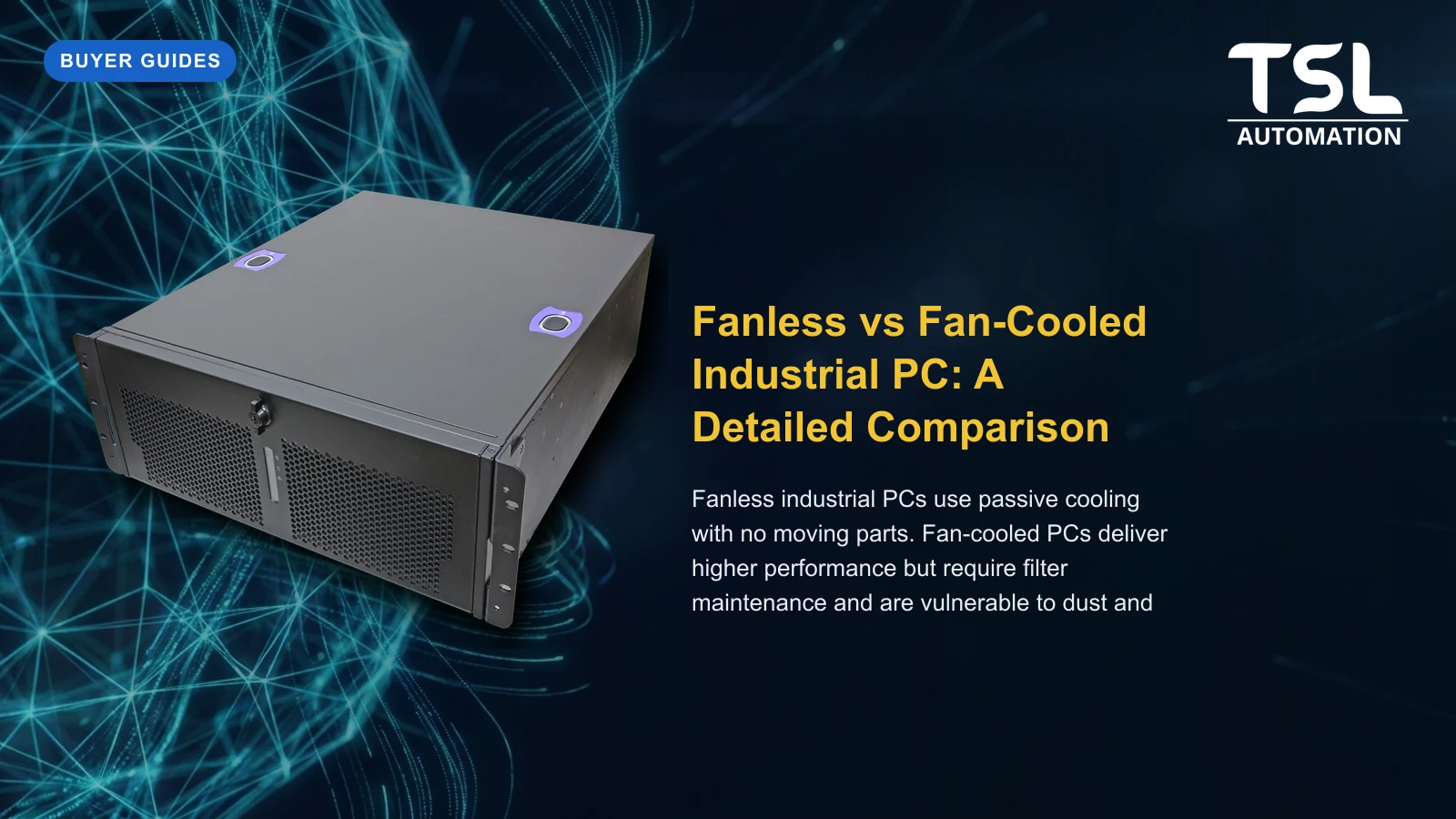
Fanless Industrial PC: How It Works
A fanless industrial PC uses a large aluminium heatsink chassis to conduct heat away from the processor. The entire outer surface of the unit acts as a radiator. There are no moving parts, no air vents, and no dust ingress paths. This makes fanless PCs the default choice for most industrial environments.
Fan-Cooled Industrial PC: When It Makes Sense
Some applications require very high-performance processors (Core i7/i9 at 65 do 125W TDP) that generate more heat than passive cooling can handle. In these cases, a fan-cooled industrial PC or workstation is used, but with industrial-grade fans designed for dusty environments, filterable intake vents, and longer bearing life (50,000+ hours).
Side-by-Side Comparison
| Feature | Fanless | Fan-Cooled |
|---|---|---|
| Moving parts | None | Fan(s) |
| Dust resistance | Fully sealed | Requires filter maintenance |
| Vibration resistance | Excellent | Fan bearings vulnerable to vibration |
| Noise | Silent | Audible fan noise |
| Maintenance | None | Filter cleaning every 3 do 6 months |
| Max processor TDP | Typically 15 do 65W | 65 do 125W+ |
| Best for | Factory floor, harsh environments | Server rooms, high-performance workstations |
Recommendation for Indian Manufacturing
For 95% of Indian manufacturing applications, SCADA workstations, HMI systems, data loggers, and IoT gateways, a fanless industrial PC is the correct choice. Indian factories typically have high ambient dust, humidity, and temperature, all of which reduce fan-cooled PC reliability. Only choose a fan-cooled design when your application genuinely requires a processor TDP above 65W.
Często zadawane pytania
TSL Automation Solutions
Dyrektor marketingu, TSL Automation Solutions
Sanjana pisze o trendach w automatyce przemysłowej, premierach produktów i nowych technologiach dla TSL Automation Solutions, dystrybutora paneli HMI, paneli PC i systemów wbudowanych z siedzibą w Mumbaju, obsługującego producentów w Indiach i na całym świecie.
Potrzebna pomoc w wyborze właściwego produktu?
Nasz zespół w Mumbaju doradzi odpowiedni panel HMI, panel PC lub system wbudowany do Państwa zastosowania.
Kontakt z TSL AutomationPowiązane produkty
Powiązane artykuły
Jak wybrać serwer brzegowy AI: poradnik zakupowy dla AI & wizji maszynowej
4 sie 2026
Panel PC z Androidem czy z Windows do kiosków samoobsługowych i QSR?
20 maj 2026
COM Express, SMARC czy Qseven? Który standard Computer-on-Module (COM) wybrać
20 maj 2026