
Przewodniki zakupowe1 min czytania
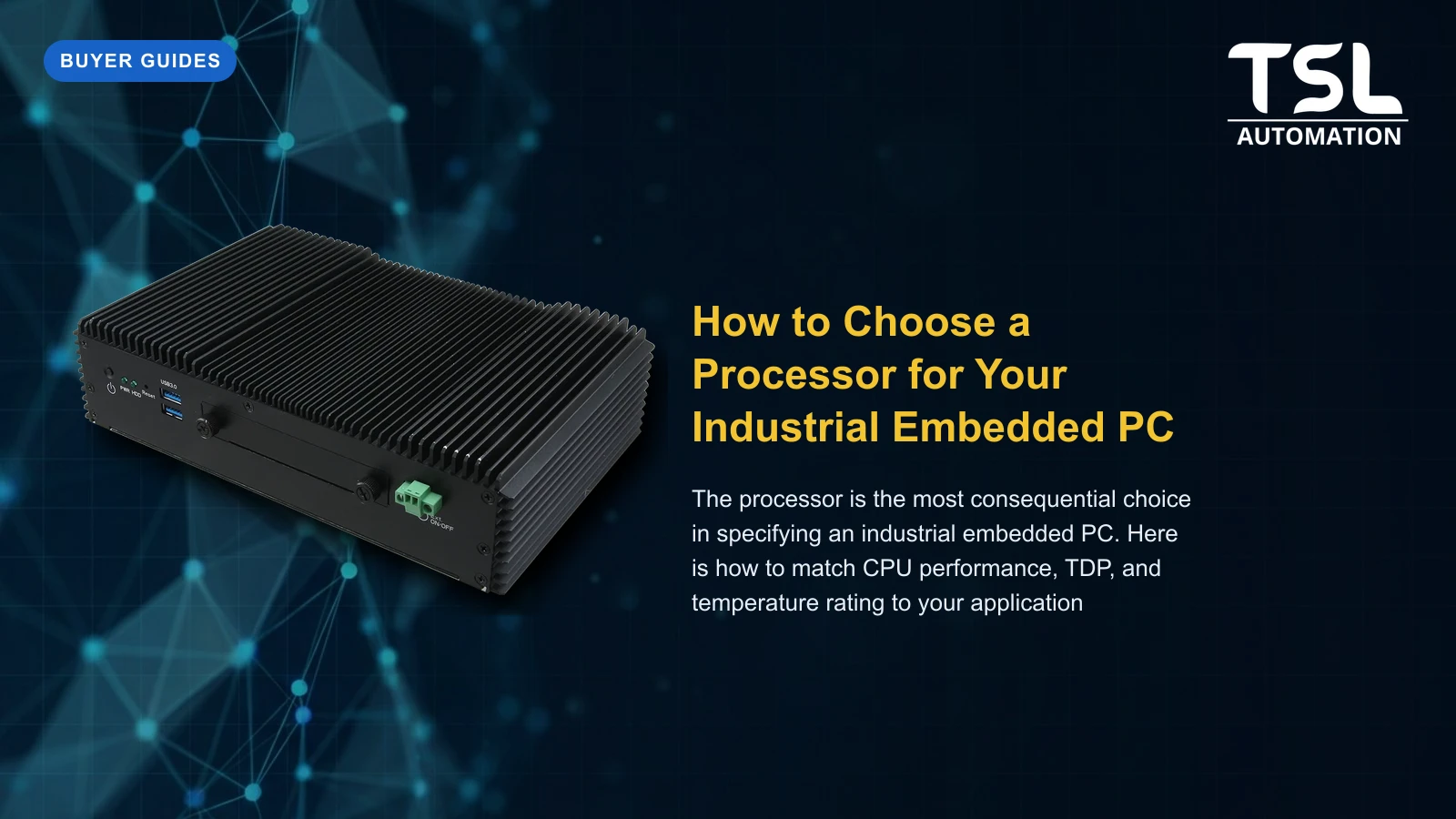
Jak wybrać procesor do przemysłowego komputera wbudowanego
TSL Automation Solutions 28 stycznia 2025 Zaktualizowano 18 maj 2026
Udostępnij
Spis treści
Industrial CPU Tiers: From Low Power to High Performance
| CPU Class | TDP | Best For |
|---|---|---|
| Intel Atom / Celeron N | 4 do 15W | IoT gateways, data loggers, simple HMI |
| Intel Core i3 / i5 (U-series) | 15 do 28W | SCADA workstations, operator panels, MES terminals |
| Intel Core i5 / i7 (H-series) | 45 do 65W | Machine vision, SCADA servers, AI edge inference |
| Intel Core Ultra / Xeon | 55 do 125W | High-performance edge computing, multi-camera vision, AI NPU |
| AMD Ryzen Embedded | 15 do 35W | High-graphics, multi-display applications |
Key Processor Considerations for Industrial Embedded PCs
- TDP vs fanless cooling, fanless chassis have a heat dissipation limit (typically 15 do 65W); never exceed the chassis TDP rating
- Industrial temperature grade, not all Intel Core processors have industrial temperature variants; confirm extended-temp support with your hardware vendor
- Long-term availability, industrial embedded processors have 7 do 10 year supply guarantees vs 2 do 3 years for consumer CPUs
- Integrated graphics vs discrete GPU, for basic SCADA displays, integrated graphics is sufficient; for machine vision or AI, a discrete GPU may be required
Matching CPU to Application
- Simple data logger / IoT gateway → Intel Atom or Celeron N, 6 do 15W fanless
- SCADA workstation (1 do 2 screens) → Core i5 U-series, 15 do 28W fanless
- Machine vision (single camera) → Core i5 or i7 H-series, 45W fanless or active cooling
- Edge AI (NPU + vision) → Intel Core Ultra with integrated NPU or Core i7 + NVIDIA GPU
Często zadawane pytania
For reliable fanless operation in ambient temperatures up to 50°C, specify processors with TDP of 15W or less (Intel Atom, Celeron N-series, Core i-series low-power variants). For ambient temperatures up to 40°C, 25 do 35W TDP processors (Core i5/i7 embedded U/H-series) are reliably cooled in well-designed fanless enclosures. Processors above 45W TDP generally require active cooling.
Intel Atom processors (x6000E Elkhart Lake series, 6 do 12W TDP) are designed for IoT gateway, edge connectivity, and protocol conversion applications, high I/O integration, low cost, lower performance. Intel Core i5/i7 (25 do 45W embedded-grade) delivers workstation-class performance for SCADA, machine vision, and AI inference. Choose Atom/Celeron for simple data collection; choose Core i5/i7 for demanding real-time processing.
SCADA client and HMI applications typically run well with 4 do 8GB RAM. SCADA servers with large tag databases need 8 do 16GB. Machine vision systems running deep learning models benefit from 16 do 32GB. IoT gateway and protocol converter applications function reliably with 4GB. As a rule, specify more RAM than your application currently requires, it is the cheapest upgrade that prevents future performance bottlenecks.
Industrial embedded PCs should use NVMe SSD (M.2 or 2.5-inch) rather than spinning hard drives. SSDs have no moving parts (critical for vibration resistance), faster boot and application load times, and operate across the full industrial temperature range. Choose industrial-grade SSDs (with power-loss protection and wide temperature ratings) rather than consumer SSDs for production applications.
Yes, TSL Automation Solutions provides application engineering support to help Indian customers select the right Avalue embedded PC processor, memory, and storage configuration for their specific application. Contact our Mumbai team with your software requirements, ambient temperature, and enclosure constraints for a recommendation.
Tagi: industrial embedded PC processor Intel Atom vs Core i industrial choose processor embedded PC industrial PC CPU selection fanless PC processor guide
Przydatne? Prosimy udostępnić
T
TSL Automation Solutions
Dyrektor marketingu, TSL Automation Solutions
Sanjana pisze o trendach w automatyce przemysłowej, premierach produktów i nowych technologiach dla TSL Automation Solutions, dystrybutora paneli HMI, paneli PC i systemów wbudowanych z siedzibą w Mumbaju, obsługującego producentów w Indiach i na całym świecie.
Potrzebna pomoc w wyborze właściwego produktu?
Nasz zespół w Mumbaju doradzi odpowiedni panel HMI, panel PC lub system wbudowany do Państwa zastosowania.
Kontakt z TSL AutomationPowiązane artykuły
Przewodniki zakupowe
Jak wybrać serwer brzegowy AI: poradnik zakupowy dla AI & wizji maszynowej
4 sie 2026
Przewodniki zakupowe
Panel PC z Androidem czy z Windows do kiosków samoobsługowych i QSR?
20 maj 2026
Przewodniki zakupowe
COM Express, SMARC czy Qseven? Który standard Computer-on-Module (COM) wybrać
20 maj 2026