
Come scegliere un monitor industriale: guida all'acquisto
Indice dei contenuti
Step 1: Choose Screen Size and Aspect Ratio
Industrial monitors range from 7" to 55". Choose based on viewing distance and information density:
- 7", 10", machine-mounted, close viewing
- 12", 15", standard SCADA workstation
- 17", 21", control room, multi-parameter display
- 24", 32", supervisor overview screens and video wall tiles
Step 2: Brightness for Your Environment
- 250 a 350 nits, standard indoor, ambient-lit environment
- 500 a 700 nits, bright factory floor with overhead lighting
- 1000+ nits, semi-outdoor, near windows, direct sunlight exposure
Step 3: Touch Technology
- Resistive touch, works with gloves; single-touch only; lower cost; suitable for simple HMI use
- Capacitive touch, multi-touch, fast response; requires bare fingers or conductive gloves
- PCAP (Projected Capacitive), most responsive; water-rejection algorithms; best choice for new installations
Step 4: IP Rating and Mounting
For panel-mount or open-frame monitors, confirm the front-panel IP rating. IP65 is the minimum for most factory environments. Open-frame monitors (no bezel or case) are installed inside custom enclosures and can have full IP65/IP67 front seals.
Step 5: Interface
Check that the display interface (HDMI, DisplayPort, VGA, DVI, or LVDS) matches your computer's outputs. For embedded systems, LVDS or eDP connections are common. For external monitors, HDMI or DisplayPort is standard.
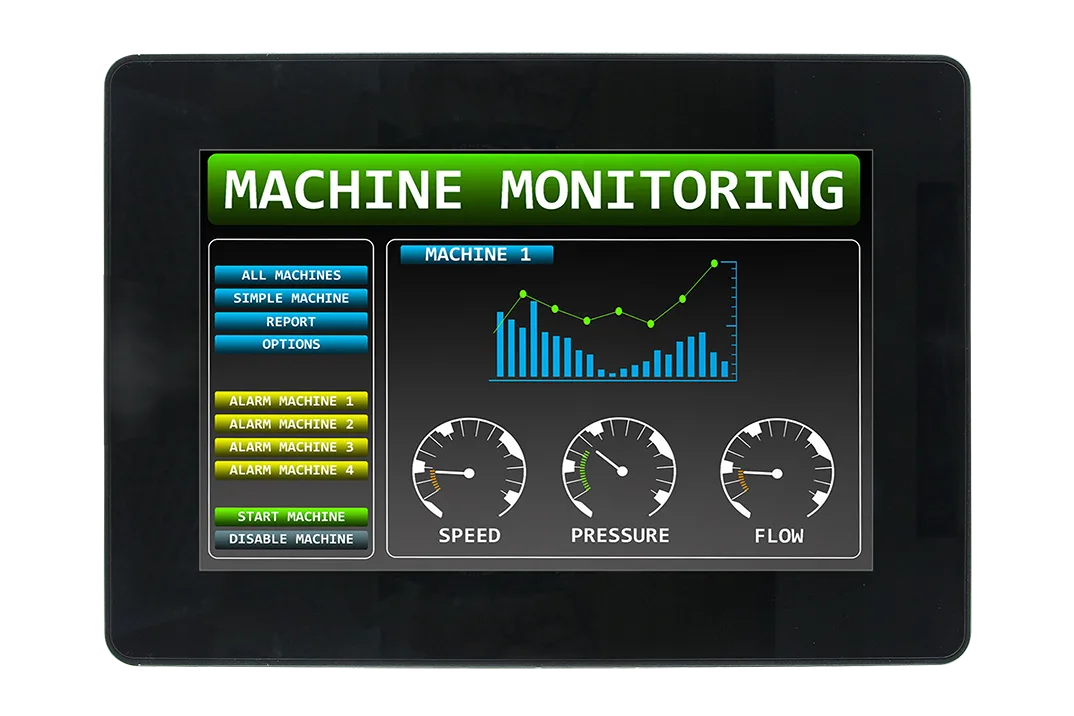
TSL Automation supplies Avalue open-frame and panel-mount industrial monitors in sizes from 7" to 21.5", contact us to find the right display for your project.
Domande frequenti
TSL Automation Solutions
Responsabile marketing, TSL Automation Solutions
Sanjana si occupa di tendenze dell'automazione industriale, lanci di prodotto e approfondimenti tecnologici per TSL Automation Solutions, distributore con sede a Mumbai di HMI, Panel PC e sistemi di computing embedded al servizio dei produttori in India e nel mondo.
Ha bisogno di aiuto per scegliere il prodotto giusto?
Il nostro team di Mumbai può consigliarle l'HMI, il Panel PC o il sistema embedded giusto per la sua applicazione.
Contatti TSL AutomationProdotti correlati
Articoli correlati
Come scegliere un server edge AI: guida all'acquisto per AI in loco & visione artificiale
4 ago 2026
Panel PC Android o Windows per chioschi self-service e ristorazione rapida: quale scegliere?
20 mag 2026
COM Express, SMARC o Qseven: quale standard Computer-on-Module (COM) scegliere?
20 mag 2026