Logo TSL Automation Solutions
Tecnologia1 min di lettura

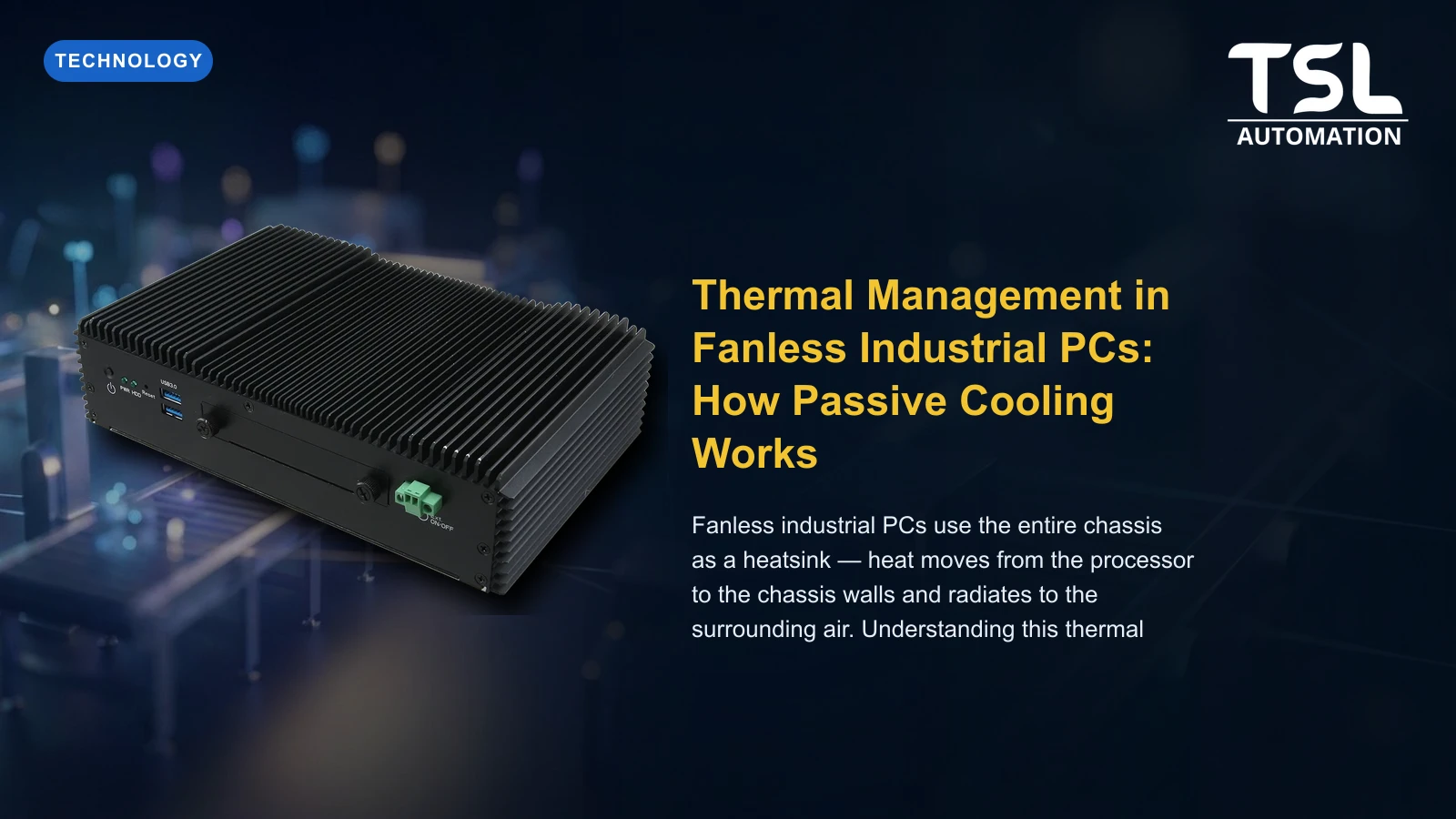
Gestione termica nei PC industriali senza ventola: il raffreddamento passivo
TSL Automation Solutions 9 luglio 2024 Aggiornato il 18 mag 2026
PC industriale senza ventola, gestione termica e raffreddamento passivo, TSL Automation Solutions
Condividi

Indice dei contenuti

How Passive Cooling Works in Fanless PCs

In a fanless industrial PC, processor heat travels through a thermal interface material (TIM) to a copper or aluminium spreader plate, through heat pipes (in some designs) to the chassis walls, and then radiates and convects from the outer surface to the surrounding air. The entire chassis acts as a heatsink, external fins on the top and sides maximise surface area for heat dissipation.

TDP: The Critical Design Limit

Every fanless chassis has a maximum TDP (Thermal Design Power) rating, typically 15W, 25W, 35W, 45W, or 65W. The processor's TDP must not exceed the chassis rating, otherwise the processor will thermally throttle (reduce clock speed to reduce heat output) or, in extreme cases, trigger a thermal shutdown. Always match your processor TDP to the chassis specification.

Effect of Ambient Temperature

Passive cooling efficiency decreases as ambient temperature increases, there is less temperature differential between the chassis surface and the surrounding air. A fanless PC rated to 60°C ambient with a 35W processor may only be rated to 45°C with a 45W processor. Always check the thermal derating curves in the product datasheet.

Installation Best Practices

  • Allow airflow around the chassis, do not install directly against a wall or inside a sealed enclosure without ventilation provisions
  • Avoid stacking, do not stack multiple fanless PCs without spacing for heat dissipation
  • Monitor ambient temperature, if control panel temperatures exceed rated ambient, add forced air cooling to the enclosure (not the PC itself)
  • Orient fins correctly, if the chassis has fins, orient them vertically for maximum natural convection

Domande frequenti

Fanless industrial PCs transfer heat from the processor via a thermal interface material (TIM) to a heat spreader, then through heat pipes or direct conduction through the aluminium chassis walls to the external surface, where natural convection or conduction to a mounting surface dissipates the heat to the environment. The entire process relies on good thermal contact at each interface, no air movement inside the sealed enclosure.
Well-designed fanless industrial PCs with 15 a 25W TDP processors reliably operate in ambient temperatures of 0°C to 60°C. Models with ultra-low-power processors (6 a 10W TDP) can operate up to 70°C ambient. Operation above the rated temperature causes thermal throttling (processor reduces speed to limit heat) and accelerates component aging. Always verify the rated operating temperature against your actual installation environment.
Yes, fanless industrial PCs thermally perform best when mounted vertically (natural convection aids heat flow upward from the warm chassis surface) or horizontally on a thermally conductive metal panel (conducts heat away from the chassis directly). Mounting inside an insulated enclosure without airflow significantly increases chassis temperature. Always check the vendor's thermal requirements for the specific mounting orientation specified in your installation.
Modern fanless industrial PCs have thermal protection: the processor throttles its clock speed automatically when junction temperature approaches the limit (typically 100 a 105°C), reducing heat output at the cost of performance. If temperature continues rising, the OS triggers a thermal shutdown to prevent hardware damage. A system that frequently throttles or shuts down thermally indicates the installation environment is too hot or the thermal interface to the mounting surface is inadequate.
Yes, TSL Automation Solutions provides thermal installation guidelines for all Avalue fanless industrial PCs we supply, including maximum ambient temperature ratings, mounting orientation recommendations, and enclosure thermal design advice. Contact our Mumbai team with your enclosure dimensions and ambient temperature for thermal suitability verification.
Tag: fanless PC thermal management passive cooling industrial PC fanless PC heat dissipation fanless PC TDP limit industrial PC thermal design
Le è stato utile? Lo condivida
T

TSL Automation Solutions

Responsabile marketing, TSL Automation Solutions

Sanjana si occupa di tendenze dell'automazione industriale, lanci di prodotto e approfondimenti tecnologici per TSL Automation Solutions, distributore con sede a Mumbai di HMI, Panel PC e sistemi di computing embedded al servizio dei produttori in India e nel mondo.

Ha bisogno di aiuto per scegliere il prodotto giusto?

Il nostro team di Mumbai può consigliarle l'HMI, il Panel PC o il sistema embedded giusto per la sua applicazione.

Contatti TSL Automation