What Is ERP in Manufacturing? How SAP and Oracle Connect to Your Factory Floor
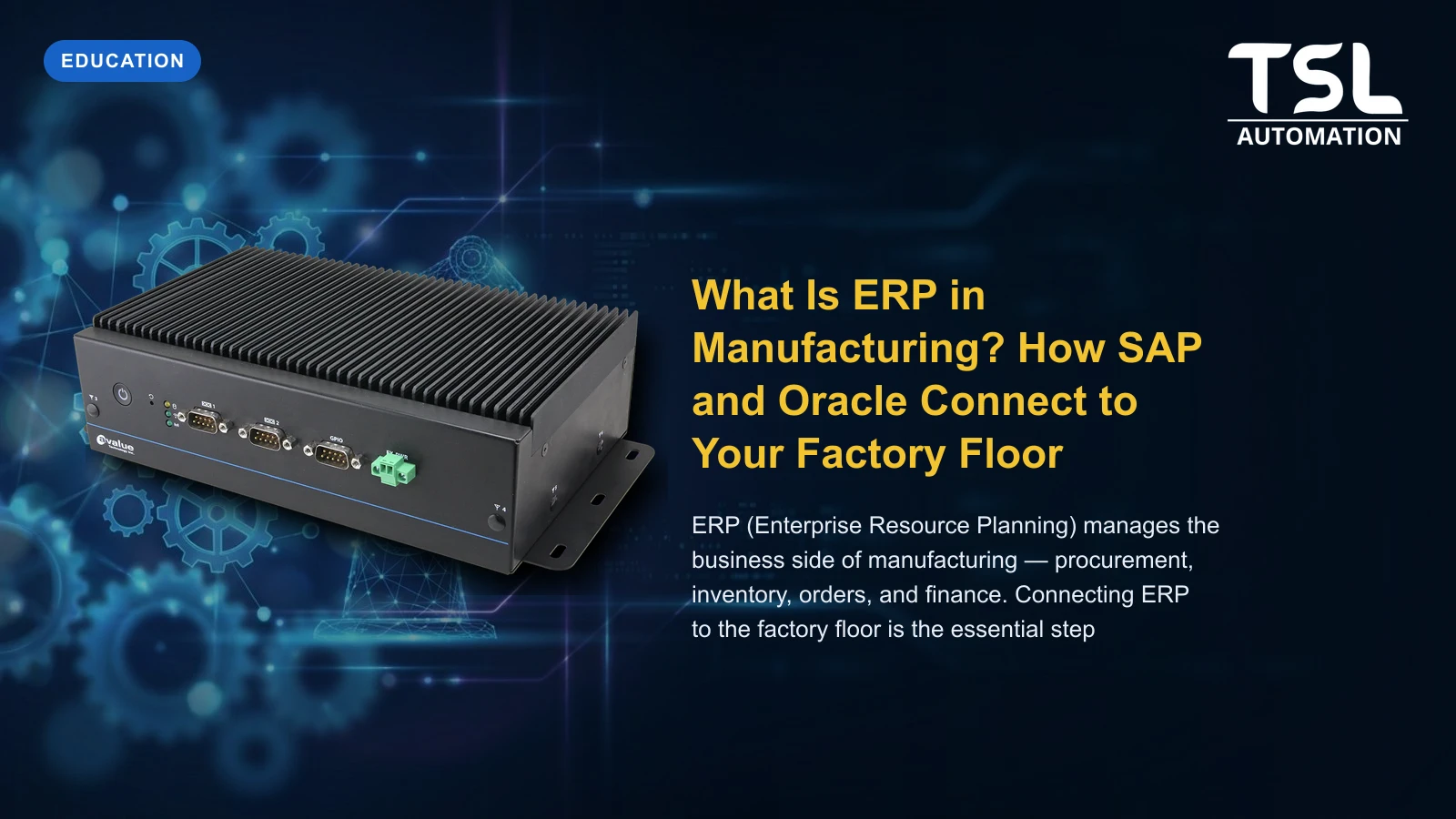
Table of Contents
What Is ERP in a Manufacturing Context?
Enterprise Resource Planning (ERP) is the integrated business software that manages all the resource-related aspects of a manufacturing company — procurement, inventory management, production planning, quality management, sales, finance, and human resources. In manufacturing, the dominant ERP platforms are SAP S/4HANA, Oracle Manufacturing Cloud, Microsoft Dynamics 365, and — widely used in Indian SMEs — Tally ERP, Infor, and Epicor.
ERP operates at the business level: it knows what orders need to be fulfilled, what materials are in stock, and what the financial cost of production is. What it does not inherently know — without integration — is what is actually happening on the factory floor at any given moment.
ERP vs MES vs SCADA: The Three-Layer Model
Modern manufacturing IT is typically visualised in three layers (the ISA-95 / Purdue model):
- Level 0–2: Control layer — PLCs, HMIs, SCADA. Real-time machine control.
- Level 3: Execution layer — MES. Production execution, traceability, OEE.
- Level 4: Business layer — ERP. Orders, planning, procurement, finance.
ERP handles planning (what to make, when, with what materials). MES handles execution (making it happen on the floor). SCADA handles real-time control (making machines operate correctly).
How ERP Connects to the Factory Floor
The integration between ERP and the factory floor typically uses one of the following approaches:
- OPC UA — the industrial interoperability standard, increasingly used to pass production data (actual vs planned quantities, quality results) from MES/SCADA up to ERP
- REST APIs / web services — modern ERP platforms expose REST APIs; MES systems call these APIs to report production completions, material consumption, and quality results
- Database integration — older integration approaches where MES writes production data directly to ERP database tables (less preferred due to upgrade risk)
- SAP Plant Connectivity (PCo) / SAP Manufacturing Integration and Intelligence (MII) — SAP's own middleware for factory floor integration
Industrial PCs as ERP Terminal Nodes
On the factory floor, operators interact with ERP (or more commonly the MES layer that feeds ERP) via industrial PC terminals. These terminals must:
- Run the ERP client or browser-based ERP interface reliably
- Survive the factory environment (dust, vibration, temperature)
- Support barcode scanners, RFID readers, and label printers
- Operate touchscreen-first for gloved operators
- Stay available 24/7 with minimal maintenance
Practical Advice for Indian Manufacturers Integrating ERP
Many Indian manufacturers run SAP Business One, Tally, or Microsoft Dynamics. The first step towards factory floor ERP integration is not a full MES — it is adding shop floor data collection terminals connected to your existing ERP. Avalue Panel PCs running a browser-based ERP client or SAP Fiori provide a rugged, long-life terminal that can survive factory environments where a standard desktop PC would fail within 18 months.
TSL Automation Solutions supplies Avalue Panel PCs as ERP and MES operator terminals for Indian manufacturing facilities. Contact us to discuss terminal specifications for your ERP integration project.
Frequently Asked Questions
TSL Automation Solutions
Head of Marketing, TSL Automation Solutions
Sanjana covers industrial automation trends, product launches, and technology insights for TSL Automation Solutions, a Mumbai-based distributor of HMI, Panel PC, and embedded computing systems serving manufacturers across India and globally.
Need help choosing the right product?
Our team in Mumbai can recommend the right HMI, Panel PC, or embedded system for your application.
Contact TSL Automation