What Is DICOM and DIN 6868-157? Choosing the Right Medical Display Grade
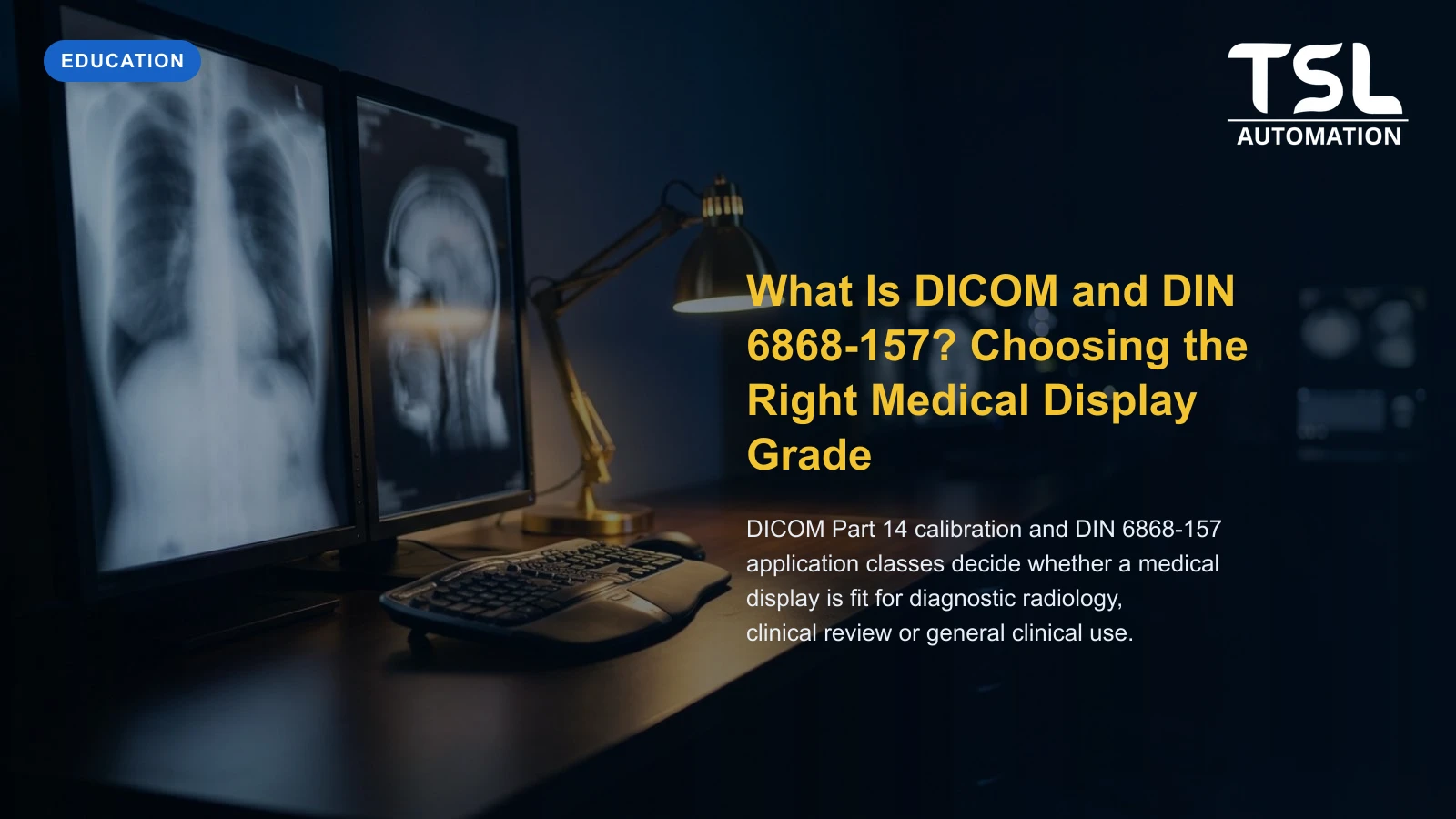
Table of Contents
Why "medical display" isn't one thing
A medical display is not a single category. The same panel can be acceptable in a nurses' station and unacceptable for radiology — and the standards that distinguish them are DICOM Part 14 and DIN 6868-157. Pick the wrong grade and you either overspend or, worse, fail the German RöV/QS audit or your hospital's clinical-image governance.
DICOM Part 14: the grayscale calibration
DICOM (Digital Imaging and Communications in Medicine) Part 14 defines the Grayscale Standard Display Function (GSDF) — a perceptually linear mapping from input pixel values to luminance. Calibrating a display to GSDF makes the same medical image look consistent across devices: a faint nodule that's visible on the radiologist's monitor will still be visible on the referring clinician's screen. A "DICOM mode" or DICOM calibration on a medical monitor means it's been measured and tuned to follow this curve.
DIN 6868-157: the German application-class standard
DIN 6868-157 goes a step further. It defines application classes based on what the display is used for, and sets minimum luminance, contrast, ambient illuminance and quality-assurance requirements for each:
- Diagnostic radiology — highest luminance, strict QA, often dual-head for mammography
- Clinical review — for image interpretation outside the reading room
- Other clinical use — image viewing where the display is not the basis of a primary diagnosis
- Image-based intervention (e.g., OR displays) — separate requirements driven by the procedure
If you operate in Germany, DIN 6868-157 compliance is a regulatory expectation. Outside Germany, it's a useful proxy: "DIN 6868-157 compliant" tells you the manufacturer has actually engineered the panel for clinical luminance and stability, not just slapped a sticker on a consumer monitor.
How to choose
- Define the use case first: diagnostic radiology vs clinical review vs general patient-room display vs OR/surgical.
- Match the standard: diagnostic = DICOM-calibrated + DIN 6868-157 diagnostic-class; review = DICOM mode + clinical-review class; OR/clinical = medical-grade build (IEC 60601-1) with DICOM mode optional.
- Check QA support: does the display offer DICOM auto-calibration and a documented QA workflow? Without QA, calibration drifts and you fail audits.
- Match the physical build: front IP65, fanless and antimicrobial for wipe-down clinical environments.
Where TSL Automation fits
TSL Automation supplies Avalue's medical display portfolio worldwide. The GMD series spans 23.8" / 27" / 32" / 55" / 65" from Full HD to 4K UHD and 4MP, supports DICOM calibration and colour calibration, with selected models compliant with DIN 6868-157 — suitable for operating-room displays, endoscopy visualisation and diagnostic imaging. The HID-2100 21.5" medical touch display supports DICOM mode with front IP65 and is designed for clinical workstations and bedside terminals. See our GMD/HID-2100 overview for the current lineup, or contact our team with your application class and we'll match the right model.
Frequently Asked Questions
TSL Automation Solutions
Head of Marketing, TSL Automation Solutions
Sanjana covers industrial automation trends, product launches, and technology insights for TSL Automation Solutions, a Mumbai-based distributor of HMI, Panel PC, and embedded computing systems serving manufacturers across India and globally.
Need help choosing the right product?
Our team in Mumbai can recommend the right HMI, Panel PC, or embedded system for your application.
Contact TSL Automation