Rising Memory Prices in 2026: What the DRAM Surge Means for Industrial PC Buyers
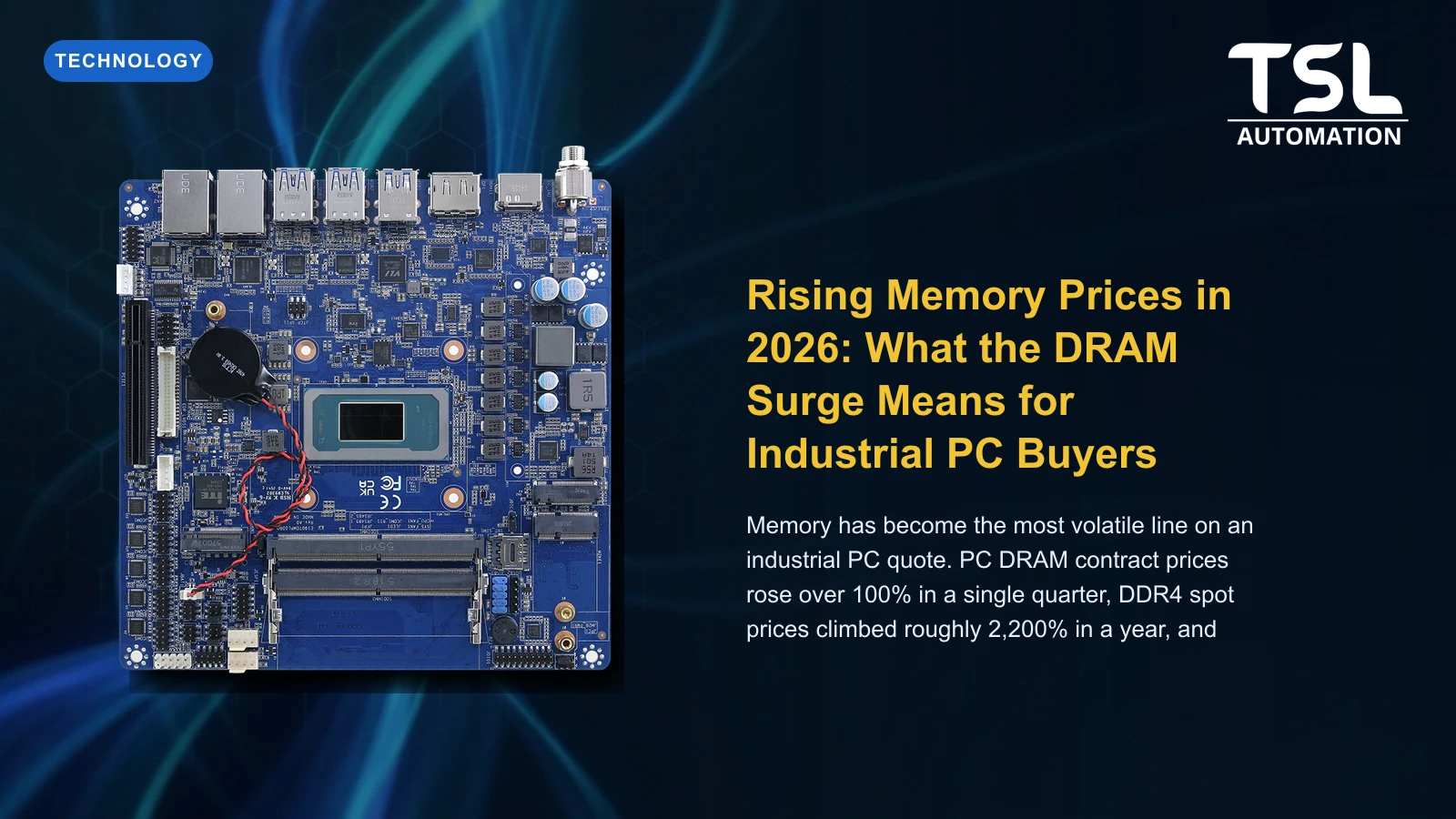
Table of Contents
How much have memory prices actually risen?
More than most buyers realise. TrendForce's February 2026 outlook put PC DRAM contract prices up more than 100% quarter-over-quarter, the largest quarterly surge on record, with server DRAM close behind at roughly 90% (TrendForce, Feb 2026). That followed fourth-quarter 2025 contract prices already running more than 75% above the prior year (TrendForce, Nov 2025).
Zoom out and the picture is starker. J.P. Morgan Research estimates DRAM prices will have risen more than 400% between the start of 2024 and the end of 2026, and notes the US import price index for computers and parts is already up 37% (J.P. Morgan, Aug 2026). NAND has moved too: enterprise SSD contract prices rose a record 53 to 58% in the first quarter of 2026.
Why is this happening?
One word: AI. Memory makers are reallocating wafers and new capacity toward server products and high-bandwidth memory (HBM) for AI accelerators. HBM's share of total DRAM wafer input is climbing from roughly 18% in 2025 to 22% in 2026, heading for 30% in 2027, which squeezes the capacity left for conventional DRAM (TrendForce, Jun 2026).
Demand is so strong that SK hynix told investors in October 2025 that its entire DRAM, NAND and HBM capacity for 2026 was already sold out (TechSpot, Oct 2025). When the world's second-largest memory maker has nothing left to sell for a full year, pricing power sits entirely with the supplier.
Why legacy DDR4 platforms are hit hardest
Counterintuitively, the older, cheaper memory is where the pain concentrates. TrendForce flagged as early as September 2025 that legacy-process products, DDR4 among them, were rising faster than newer generations (TrendForce, Sep 2025). By March 2026, DDR4 16Gb spot prices had climbed roughly 2,200% in twelve months before posting their first dip, about 5%, in nearly a year (Tom's Hardware, Apr 2026).
The reason is structural, not cyclical. Samsung's DDR4 supply is set to drop sharply in 2026, SK hynix signals a phase-out despite briefly boosting output at Wuxi, and Micron announced its exit from the consumer memory market effective early 2026 (TrendForce, Jan 2026). Industrial platforms live for 7 to 15 years, far longer than consumer PCs, so plants running DDR4-era controllers and panel PCs face a shrinking, more expensive supply pool for the rest of those systems' lives. If you are weighing memory generations for a new design, our DDR5 vs DDR4 guide covers the technical trade-offs.
What does the surge do to industrial PC costs?
Memory is no longer a rounding error on the bill of materials. TrendForce calculates DRAM plus NAND moved from 10 to 18% of a notebook's BOM cost before the surge to over 20% in 2026 (TrendForce, Nov 2025). Industrial PCs carry the same memory types, so the same pressure lands on panel PCs, box PCs and SBCs, on top of it, wide-temperature and ECC industrial SKUs sit in narrower supply channels to begin with.
The second effect is speed. TrendForce raised its own first-quarter 2026 DRAM forecast from 55 to 60% growth to 90 to 95% within four weeks (Jan 5 to Feb 2 releases). In a market that re-prices monthly, supplier quotes age quickly, and a configuration priced in one quarter can look very different in the next.
How long will high memory prices last?
Do not plan around a quick correction. TrendForce's third-quarter 2026 outlook still shows conventional DRAM rising 13 to 18% quarter-over-quarter, a slower climb only because consumer buyers are, in its words, reaching their affordability limit (TrendForce, Jul 2026). J.P. Morgan expects the industry to stay in shortage for multiple years, and HBM contract prices are projected to surge further into 2027 as its wafer share grows. Prices rising more slowly is not prices falling.
What should industrial buyers do now?
Five practical moves, in the order we suggest applying them:
- Lock configurations early. Freeze memory size and type at design sign-off and order against a schedule rather than ad hoc, so each purchase does not re-enter a rising spot market.
- Treat quotes as short-lived. When forecasts double in four weeks, 30-day pricing assumptions are optimistic. Confirm validity windows with every quotation.
- Start new designs on DDR5. The DDR4 squeeze is structural, three major makers are winding it down. New projects on DDR5-based boards avoid buying into a shrinking supply pool.
- Plan last-time buys for DDR4 fleets. If your installed base runs DDR4 platforms, budget spare modules now for the fleet's remaining service life rather than sourcing reactively in 2027.
- Use distributor stock as a buffer. Scheduled orders and held inventory smooth out quarter-to-quarter swings, ask us about locking supply for multi-quarter rollouts via our catalogue.
Memory pricing is now a supply-chain risk item, not a line-item detail. The buyers who treat it that way, locking configurations, dating their quotes and planning legacy buys, will ride out the surge with far less budget pain than those who wait for the correction that analysts say is not coming soon.
Frequently Asked Questions
TSL Automation Solutions
Head of Marketing, TSL Automation Solutions
Sanjana covers industrial automation trends, product launches, and technology insights for TSL Automation Solutions, a Mumbai-based distributor of HMI, Panel PC, and embedded computing systems serving manufacturers across India and globally.
Need help choosing the right product?
Our team in Mumbai can recommend the right HMI, Panel PC, or embedded system for your application.
Contact TSL Automation