Sunlight-Readable Displays: Nits, Optical Bonding and When You Need Them
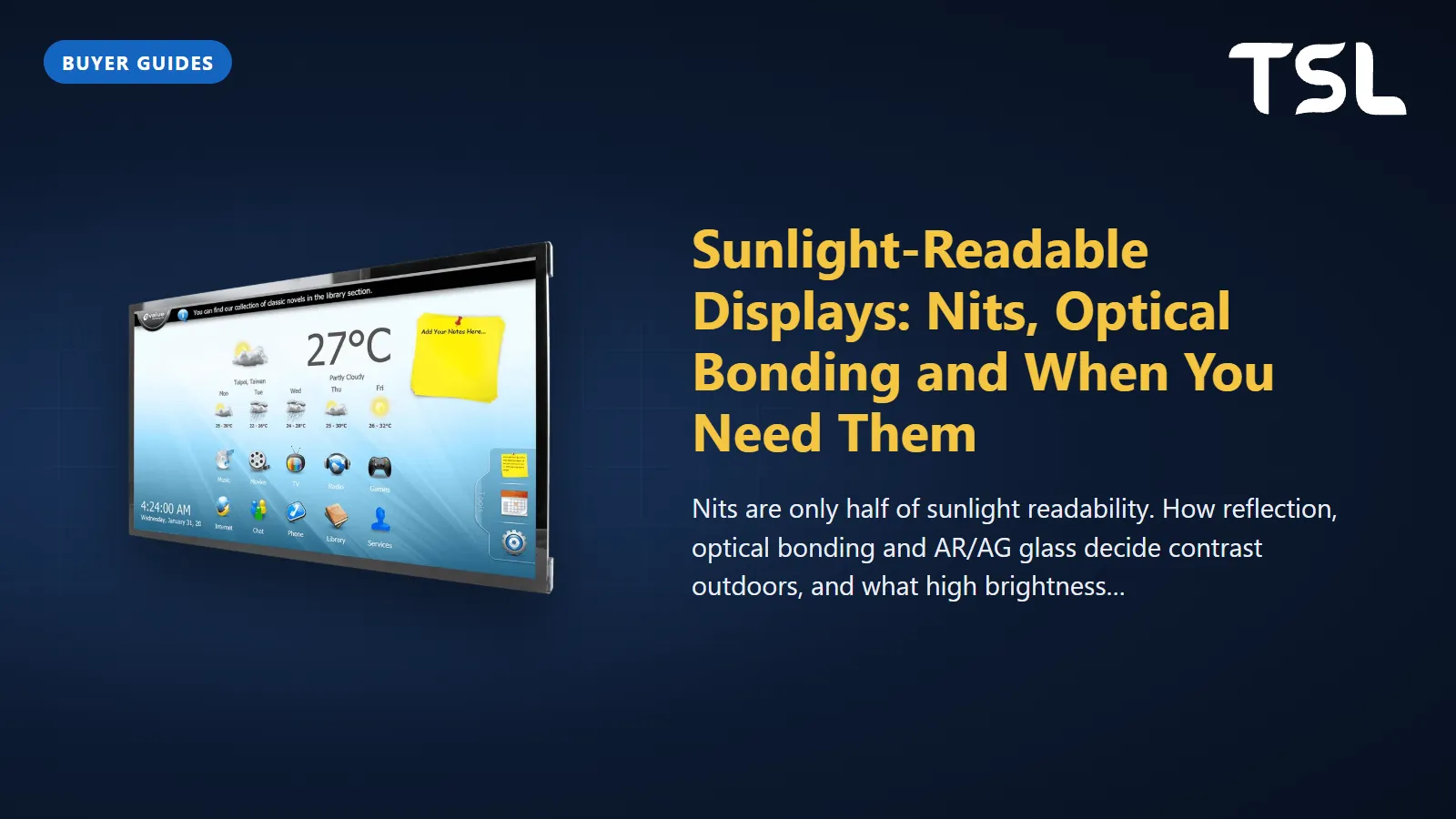
Table of Contents
A display is sunlight readable when the light it emits is clearly stronger than the sunlight reflected off its front surface. Brightness, measured in nits (cd/m²), is only half of that equation: cutting reflection with optical bonding and anti-reflective glass often does more than doubling the backlight. As a starting point, an ordinary indoor panel of 250 to 400 nits is fine under factory lighting, while a screen in direct sun usually needs around 1,000 nits or more together with a low-reflection front.
This guide explains how brightness is specified, how to estimate readability in daylight, what optical bonding and AG/AR treatments actually change, and the heat, power and temperature cost of a high-brightness screen.
What nits and cd/m² measure
Luminance is the light a surface emits (or reflects) per unit area in a given direction. Its SI unit is the candela per square metre, cd/m², and the IALA dictionary notes that this unit is sometimes called the nit (IALA). So "1,000 nits" and "1,000 cd/m²" on a datasheet mean the same thing.
To put numbers on it, here are luminance values from the records of displays we supply:
- Standard open-frame touch monitor: 250 cd/m² (19-inch OFM-1900).
- Bright indoor panel PC: 600 cd/m² (12.1-inch ARC-1242).
- Outdoor-class panel PCs: 1,200 cd/m² on the 10.1-inch RPC-10VX, 1,400 on the 21.5-inch RPC-21VX and 1,600 on the 32-inch RPC-32VX.
The datasheet figure is the panel's maximum at the centre, with the backlight at full power. It says nothing about how much ambient light the front glass reflects back at the operator, which is where readability is usually won or lost.
Why brightness alone does not make a screen readable
What the eye needs is contrast between what the display emits and what it reflects. Geoff Walker, technology editor at RuggedPCReview, expresses this as an effective contrast ratio: ECR = 1 + (emitted light / reflected light). In the same article he puts sunlight at roughly 30,000 to 100,000 lux and notes that the low end of the sunlit background is usually specified as 10,000 nits (RuggedPCReview, 2007). His readability scale:
| Effective contrast ratio | Readability outdoors (Walker) |
|---|---|
| 1 to 2 | Unreadable in sunlight |
| 3 to 4 | Readable in shade, barely readable in sunlight |
| 5 to 9 | Adequately readable in sunlight |
| 10 | Very readable in sunlight |
| 15 and above | Outstanding |
A simplified worked example shows why reflection matters so much. Take Walker's 10,000-nit sunlit background, multiply it by the total reflectance of the display front to get the reflected light, and apply his formula:
| Front reflectance | Reflected light | 300-nit panel | 1,000-nit panel | 1,600-nit panel |
|---|---|---|---|---|
| 20% (untreated, air-gapped touch stack) | 2,000 nits | ECR 1.2 | ECR 1.5 | ECR 1.8 |
| 5% (AR coatings on each surface) | 500 nits | ECR 1.6 | ECR 3.0 | ECR 4.2 |
| 1% (low-reflection stack) | 100 nits | ECR 4.0 | ECR 11 | ECR 17 |
The reflectance rows come from Walker's figures for a 2007 touch-screen stack: 20% untreated, about 5% with AR coatings on all five surfaces, and 0.9% to 1.7% for his best low-reflection constructions (RuggedPCReview). Real figures depend on viewing angle and the actual stack, so treat this as an illustration rather than a prediction. The lesson holds: at 5% reflectance even 1,600 nits is only "barely readable", while a 1,000-nit panel behind a 1% front is very readable.
Optical bonding vs air gap
Most touch displays are built as layers: cover glass, touch sensor and LCD. In an air-gap build these sit with a thin layer of air between them, and every glass-to-air surface reflects light. VIA optronics, a bonding specialist, gives approximately 4% reflection at an idealised air-glass interface for light striking it perpendicularly (VIA optronics). Two or three of those internal surfaces add up quickly.
Optical bonding fills the gap with a clear adhesive (a silicone-based material, an optically clear adhesive film called OCA, or a liquid optically clear adhesive called LOCA), so the internal glass-to-air surfaces disappear. VIA lists the practical effects: higher perceived contrast in bright ambient light, no condensation or dust in the filled space, and reduced parallax between the touch point and the image. It also cautions that the shock, vibration or fracture resistance of the bonded module must be verified on the complete display assembly, and that rework depends on the material and on the parts being reusable (VIA optronics).
| Air gap | Optical bonding | |
|---|---|---|
| Internal reflections | Every internal glass-to-air surface reflects (about 4% each at normal incidence) | Internal glass-to-air surfaces removed; only the outer surface remains |
| Readability in daylight | Limited, even with a bright backlight | Better contrast at the same brightness |
| Condensation and dust between layers | Possible with temperature swings | No air space for it to form |
| Touch parallax | Larger gap to the image | Reduced |
| Repair | Cover glass or touch sensor can be replaced separately | Depends on adhesive; some materials are reworkable |
| Availability | Standard on most panels | Standard on some models, a customised option on others |
On Avalue products, bonding appears in two ways. Some displays ship bonded as standard: the OFM-3700 is listed with optical bonding and low-reflect cover glass, and the OFM-2700 with an optically bonded 800-nit panel. On the panel kits for OEM builds, such as the 600-nit PCC-ARC-AB12-R, optical bonding, higher brightness and anti-reflective, anti-glare, anti-fingerprint and anti-UV coatings are listed as customised options.
Anti-glare and anti-reflective treatments
These two are often confused:
- Anti-glare (AG) is a textured or etched surface. It does not reduce how much light is reflected so much as scatter it, so a lamp or the sun becomes a diffuse haze instead of a sharp mirror image. The RPC-VX panel PCs use etched AG protection glass. AG works well indoors under overhead lights; the trade-off is a slightly softer image.
- Anti-reflective (AR) is a thin optical coating that lowers the reflection itself. Riverdi gives typical reflectance of plain glass as 4 to 5%, reduced to about 1 to 2.5% with an AR coating (Riverdi), and Walker's figures show around 0.5% on an AR-coated outer surface (RuggedPCReview).
For direct sun, the combination that does the most is AR on the outer surface plus optical bonding behind it, because that attacks both the outer and the internal reflections. Anti-fingerprint coatings matter more than they sound on a touch screen used outdoors, since smears scatter light just like AG texture.
The heat and power cost of high brightness
An LED backlight running at 1,000 nits or more draws more power and turns more of it into heat inside a sealed enclosure. Riverdi notes that higher brightness drains a battery faster and that very bright displays may need fans to remove the heat (Riverdi). The datasheets reflect this: the ordering line of the 800-nit OFM-2700 lists a fan, and the 1,000-nit OFM-3700 is rated at 85 W maximum.
Three practical points:
- Budget the maximum, not the typical, power when sizing the DC supply, especially on vehicles and solar-powered kiosks.
- Use automatic dimming. The OFM-2700 has an ambient light sensor, and the SPC-1533-B1 and SPC-2133-B1 stainless steel panel PCs list an optional auto dimming and high brightness solution. Dimming at night saves power, reduces heat and avoids dazzling operators.
- Check backlight life at your duty cycle. The RPC-VX records list 50,000 hours; running continuously at full brightness uses that budget faster than a dimmed screen.
Outdoor temperature: the limit people forget
Sun on a screen heats it as well as washing it out. Riverdi explains that above a certain temperature the liquid crystal enters its isotropic phase, where it can no longer change the polarisation of light and the image blackens, and that the module as a whole is typically rated lower than the liquid crystal itself (Riverdi). Read the operating range on the record with the enclosure and solar load in mind:
| Model | Type | Luminance | Front treatment | Operating temperature |
|---|---|---|---|---|
| RPC-10VX | 10.1" ARM panel PC, Android 14, IP65 | 1,200 cd/m² | AG etched glass | 0 to 50°C |
| RPC-32VX | 32" ARM panel PC, Android 14, IP65 | 1,600 cd/m², 5,000:1 | AG etched glass | 0 to 50°C |
| OFM-2700 | 27" portrait open-frame touch monitor, IP65/IK10 front | 800 cd/m² | Optical bonding | -20 to 70°C |
| OFM-3700 | 37" 1920 x 540 bar display, EN50155/EN45545, +24 to 110 V DC | 1,000 cd/m², 5,000:1 | Optical bonding, low-reflect cover glass | -25 to 55°C |
| PCC-ARC-AB12-R | 12.1" panel kit with resistive touch, LVDS | 600 nits (higher on request) | Bonding and AR/AG as options | -30 to 85°C panel, -10 to 70°C touch |
| ARC-1242 | 12.1" panel PC, 13th Gen Intel Core, IP65 front | 600 cd/m² | 5-wire resistive touch (no bonding listed) | -10 to 50°C |
Figures are from the product records on our site. The RPC-VX panel PCs, at 0 to 50°C, suit kiosks under a canopy, semi-outdoor counters and bright lobbies better than a south-facing wall in an Indian summer. For full sun, plan a hood or shade, a light-coloured housing and ventilation, or choose a display rated higher. Our wide-temperature guide explains how to read these ratings, and IP ratings explained covers sealing against rain and wash-down.
When you need a sunlight-readable display
| Location | Starting point |
|---|---|
| Factory floor, control room, office lighting | Standard 250 to 400 nits; AG surface if overhead lights reflect |
| Near windows, skylights, loading bays | 500 to 600 nits with AG or AR glass |
| Shaded outdoor: canopy, kiosk under a roof, vehicle cab | Around 1,000 nits with AR glass or optical bonding |
| Direct sun: fuel dispensers, outdoor kiosks, platforms, marine decks | 1,000 nits or more, optical bonding plus AR, auto dimming, and a temperature rating checked against solar load |
Walker describes 1,000-nit backlights as typical for high-bright industrial displays, and Riverdi calls 1,000 nits a universal figure for very bright indoor spaces (RuggedPCReview, Riverdi), so for an air-gapped front treat 1,000 nits as the floor for outdoor work, not the target; a bonded, low-reflection front such as the 800-nit OFM-2700 can do the same job with less backlight. For wider display selection (size, resolution, interface), see how to choose an industrial display, and for the touch layer that sits in front of the panel, touch screen technologies for industrial HMIs.
A specification checklist
- Where will the screen face, and at what times of day will sun fall on it?
- Luminance in cd/m² at full brightness, and whether automatic dimming is available.
- Front construction: air gap or optically bonded; AG, AR or both; anti-fingerprint.
- Maximum power draw, and whether the unit needs a fan or relies on the enclosure.
- Operating temperature of the complete unit, with your enclosure and solar load added.
- Ingress and impact rating of the front (for example IP65 with IK08 on the RPC-32VX, IP65 with IK10 on the OFM-2700 and OFM-3700).
- Touch technology and glove use; bonding reduces parallax on PCAP touch.
How TSL can help
TSL Automation Solutions, based in Mumbai, has been an authorised Avalue and Cermate distributor since 2015 and ships worldwide. For bright and outdoor locations we supply Avalue high-brightness panel PCs (RPC-10VX, RPC-21VX, RPC-32VX), optically bonded displays (OFM-2700, OFM-3700), 600-nit industrial panel PCs such as the ARC-1242, and panel kits such as the PCC-ARC-AB12-R where bonding, higher brightness and AR/AG coatings can be specified for an OEM build. Use the product finder to narrow the range, or the compare tool to put two candidates side by side. Tell us where the screen will be mounted and which way it faces, so luminance, front treatment and temperature rating can be checked against the records.
Send us the model numbers and quantities and we will reply with availability and lead time within one business day.
Frequently Asked Questions
TSL Automation Solutions
Head of Marketing, TSL Automation Solutions
Sanjana covers industrial automation trends, product launches, and technology insights for TSL Automation Solutions, a Mumbai-based distributor of HMI, Panel PC, and embedded computing systems serving manufacturers across India and globally.
Need help choosing the right product?
Our team in Mumbai can recommend the right HMI, Panel PC, or embedded system for your application.
Contact TSL Automation