Jetson Orin Nano vs Orin NX vs AGX Orin: Choosing an Industrial Box PC
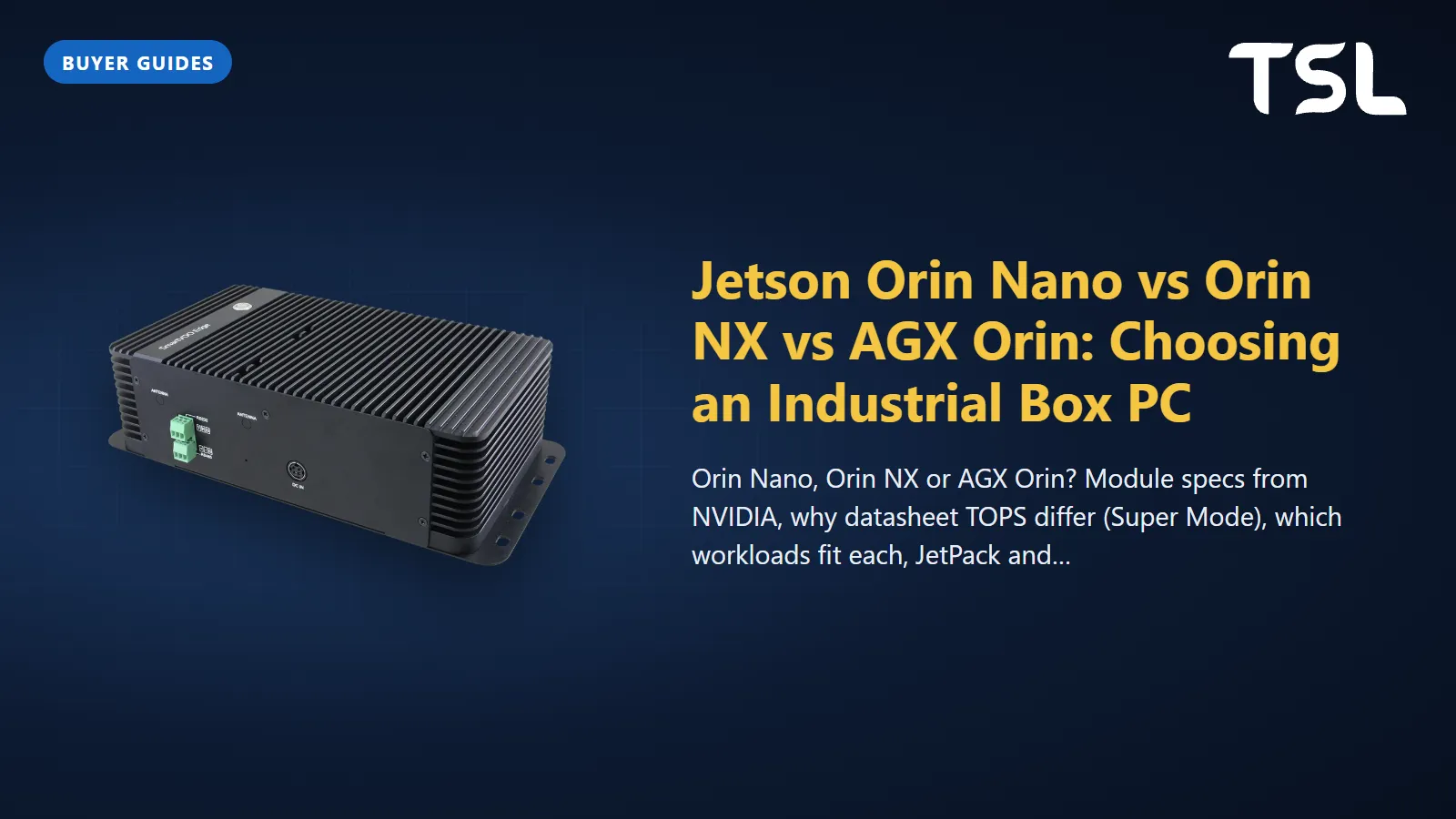
Table of Contents
Pick the Jetson Orin module by camera count, model size and video load. Orin Nano (4 or 8 GB, 6 CPU cores, no hardware video encoder) suits one to a few cameras with a compact model; Orin NX (8 or 16 GB, up to 8 cores, hardware encoder and DLA) is the usual choice for multi-camera inspection; AGX Orin (32 or 64 GB on a 256-bit memory bus) is for many streams, larger models and capture cards. NVIDIA lists all of these commercial modules as available through January 2032.
Jetson Orin Nano vs Orin NX vs AGX Orin: the specifications
All Orin modules share the same architecture: an NVIDIA Ampere GPU with Tensor Cores, Arm Cortex-A78AE CPU cores and LPDDR5 memory. The table uses NVIDIA's Jetson Orin product page; the "original" figures come from NVIDIA's JetPack 6.2 Super Mode post for Nano and NX, and from the JetPack 7.2 announcement for AGX Orin 32GB (AGX Orin 64GB is unchanged).
| Module | AI performance (sparse INT8, NVIDIA's current figure) | Original figure | GPU | CPU | Memory | Power modes |
|---|---|---|---|---|---|---|
| Orin Nano 4GB | 34 TOPS | 20 TOPS | 512 cores, 16 Tensor Cores | 6-core | 4 GB, 64-bit, 51 GB/s | 7 W, 10 W, 25 W |
| Orin Nano 8GB | 67 TOPS | 40 TOPS | 1024 cores, 32 Tensor Cores | 6-core | 8 GB, 128-bit, 102 GB/s | 7 W, 15 W, 25 W |
| Orin NX 8GB | 117 TOPS | 70 TOPS | 1024 cores, 32 Tensor Cores | 6-core | 8 GB, 128-bit, 102.4 GB/s | 10 W to 40 W |
| Orin NX 16GB | 157 TOPS | 100 TOPS | 1024 cores, 32 Tensor Cores | 8-core | 16 GB, 128-bit, 102.4 GB/s | 10 W to 40 W |
| AGX Orin 32GB | 241 TOPS | 200 TOPS | 1792 cores, 56 Tensor Cores | 8-core | 32 GB, 256-bit, 204.8 GB/s | 15 W to 60 W |
| AGX Orin 64GB | 275 TOPS | 275 TOPS | 2048 cores, 64 Tensor Cores | 12-core | 64 GB, 256-bit, 204.8 GB/s | 15 W to 60 W |
| AGX Orin Industrial | 248 TOPS | n/a | 2048 cores, 64 Tensor Cores | 12-core | 64 GB, 256-bit, with ECC | 15 W to 75 W |
Three rows on NVIDIA's page matter more for industrial vision than the headline TOPS:
- Deep learning accelerator (DLA): two NVDLA v2 engines on AGX Orin and Orin NX 16GB, one on Orin NX 8GB, none on Orin Nano. The DLA can run a second model alongside the GPU.
- Hardware video encode: AGX Orin 64GB lists up to 16 x 1080p30 H.265 streams and Orin NX up to 12 x 1080p30. For Orin Nano NVIDIA lists only "1080p30 supported by 1-2 CPU cores", meaning there is no hardware encoder.
- Video decode: from 11 x 1080p30 H.265 streams on Orin Nano to 22 on AGX Orin 64GB. This matters if your cameras are IP cameras sending compressed video rather than raw frames.
Why the TOPS figures on datasheets don't match
If you compare a box PC datasheet with NVIDIA's site, the numbers often disagree. The reason is Super Mode. In January 2025 NVIDIA released JetPack 6.2, which raised GPU, CPU and memory clocks on Orin Nano and Orin NX production modules: Orin Nano 8GB went from 40 to 67 TOPS and Orin NX 16GB from 100 to 157 TOPS, with new 25 W (Nano) and 40 W (NX) power modes plus an uncapped MAXN SUPER mode (NVIDIA). JetPack 7.2, announced in June 2026, added a Super Mode for AGX Orin 32GB, "increasing AI performance from 200 TOPS to 241 TOPS" (NVIDIA forum announcement).
Two conditions come with it, both from NVIDIA's post. The new power modes "are only available with the new flashing configuration", and you must make sure the product's thermal design can handle them. In MAXN SUPER the module throttles if it exceeds its thermal budget. So the higher figure depends on the software build and on the box's cooling, not only on the module.
The Avalue records quote the original figures (20/40 TOPS for Orin Nano, 70/100 for Orin NX, 200/275 for AGX Orin) and list JetPack 5.0 to 6.2. Treat those as the baseline. If your model needs the Super Mode figure, confirm the JetPack version and power mode the box will ship with before you order. Also remember TOPS are sparse INT8 peak values; NVIDIA's own table shows dense figures at half. The only number that matters is your model's measured frame time on the target module, as our GPU sizing guide explains.
Which workloads fit each module
Orin Nano: one to a few cameras, compact models
Orin Nano fits a single inspection station or a small number of cameras running a compact detection or classification network, plus barcode or OCR work on the CPU. Watch two limits. With 4 or 8 GB shared between CPU and GPU, large models and many frame buffers compete for the same memory. And with no hardware encoder, recording or re-streaming H.265 video from several cameras would load the CPU. If the job is "inspect and send a pass/fail signal", Nano is often enough; if it is "inspect and also record every camera", look at NX.
Orin NX: the multi-camera workhorse
Orin NX uses the same 69.6 x 45 mm, 260-pin SO-DIMM form factor as Orin Nano, and NVIDIA lists the same camera interface for both (8 MIPI CSI-2 lanes, up to 4 cameras or 8 via virtual channels). The difference is what sits behind the cameras: a faster CPU, the hardware encoder and one or two DLA engines. That makes Orin NX the usual choice for two to four inspection cameras, a model on the GPU with a second model on the DLA, or an inspection station that also records evidence video. Choose the 16GB module if the model is large or you plan to add models later.
AGX Orin: many streams, large models, capture cards
AGX Orin doubles the memory bus to 256 bits (204.8 GB/s) and offers up to 64 GB. NVIDIA lists 16 CSI-2 lanes supporting up to 6 cameras (16 via virtual channels) and more PCIe lanes. It is the module for many camera streams, larger models such as vision language models, and systems that need PCIe capture cards for GMSL2 or SDI cameras. For harsh sites NVIDIA also makes an AGX Orin Industrial module rated -40 to 85°C at the thermal transfer plate, with inline DRAM ECC and a 10-year operating lifetime (5 years for the commercial module). The Avalue AGX system below uses the commercial modules.
For when a CPU or NPU is enough and a Jetson is not needed at all, see NPU vs GPU vs CPU for edge AI. Jetson is an Arm platform, so check that your inspection software runs on Arm Linux; our Arm vs x86 guide covers that decision.
Avalue Jetson Orin box PCs we supply
The module sets the compute; the box sets the I/O, power input and operating range. Figures below are from the product records on our site.
| Model | Module (record) | AI performance (record) | Camera and network I/O | Power input | Operating temperature | Software (record) |
|---|---|---|---|---|---|---|
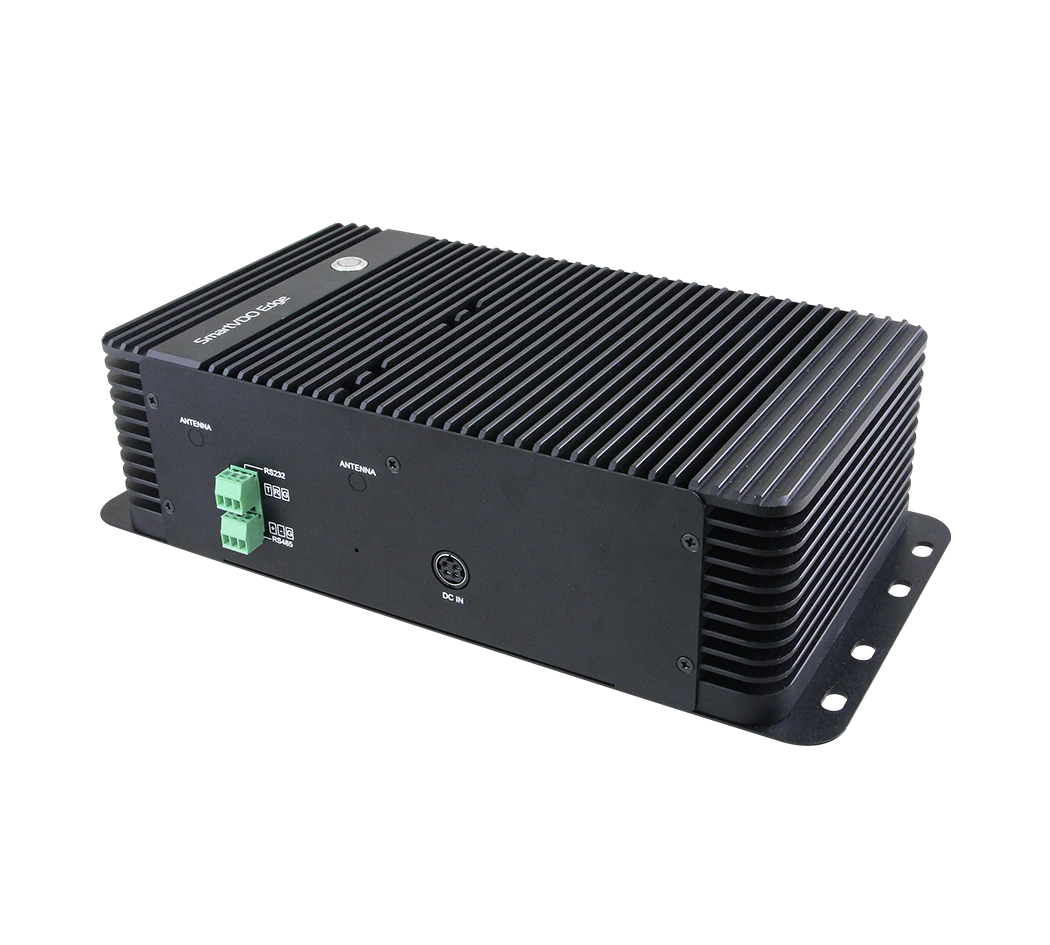
| AIB-NW01 | Orin Nano 4GB/8GB or Orin NX 8GB/16GB | 20/40 TOPS (Nano), 70/100 TOPS (NX) | 2 x GbE, 4 x USB 3.1, 2 x RS-232/RS-485, M.2 for Wi-Fi and 5G | 10 to 24 V DC | -15 to 60°C with 0.5 m/s airflow | Ubuntu 20.04, JetPack 5.0 |
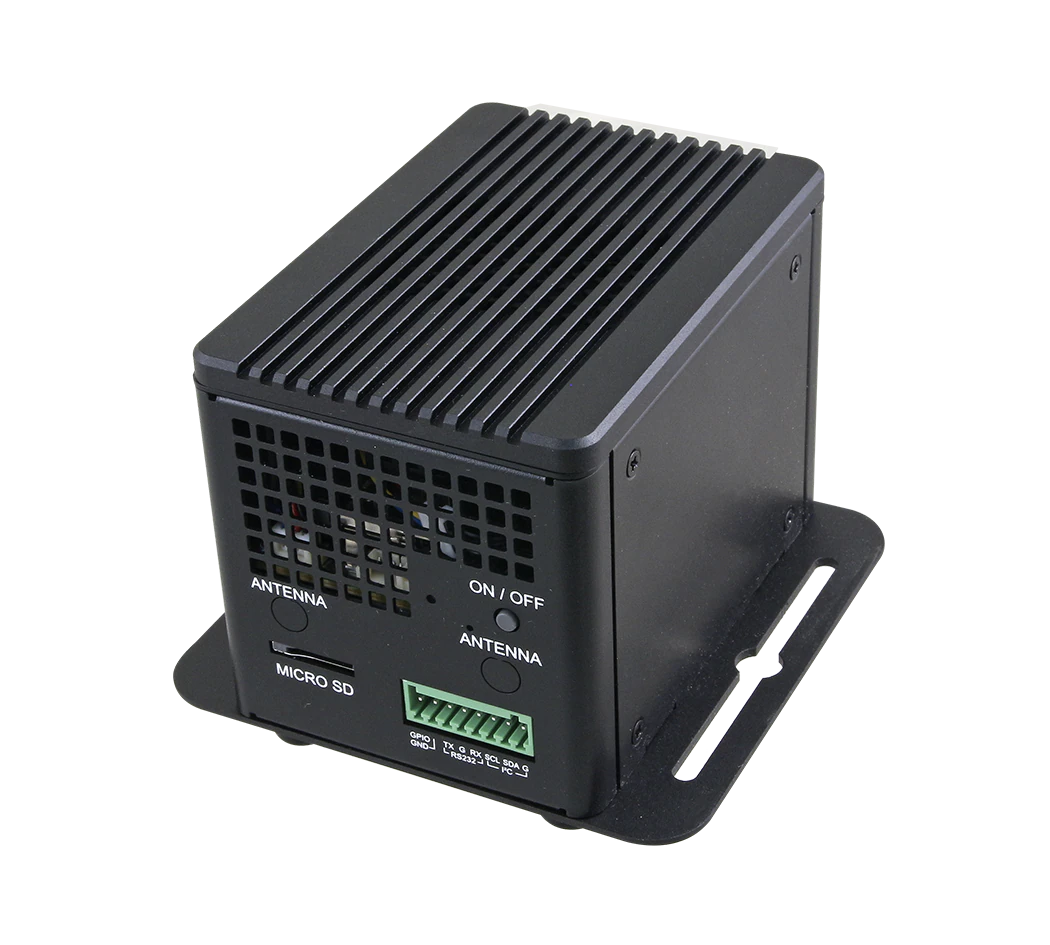
| AIB-NINX-SC | Orin NX 8GB/16GB | 70/100 TOPS | 2x4 MIPI CSI-2 lanes, 1 x GbE, CAN bus; capture-card variants for HDMI, GMSL2, 12G-SDI and TVI | 9 to 36 V DC | 0 to 60°C with airflow | Ubuntu 20.04/22.04, JetPack 5.1.1 / 6.2 |
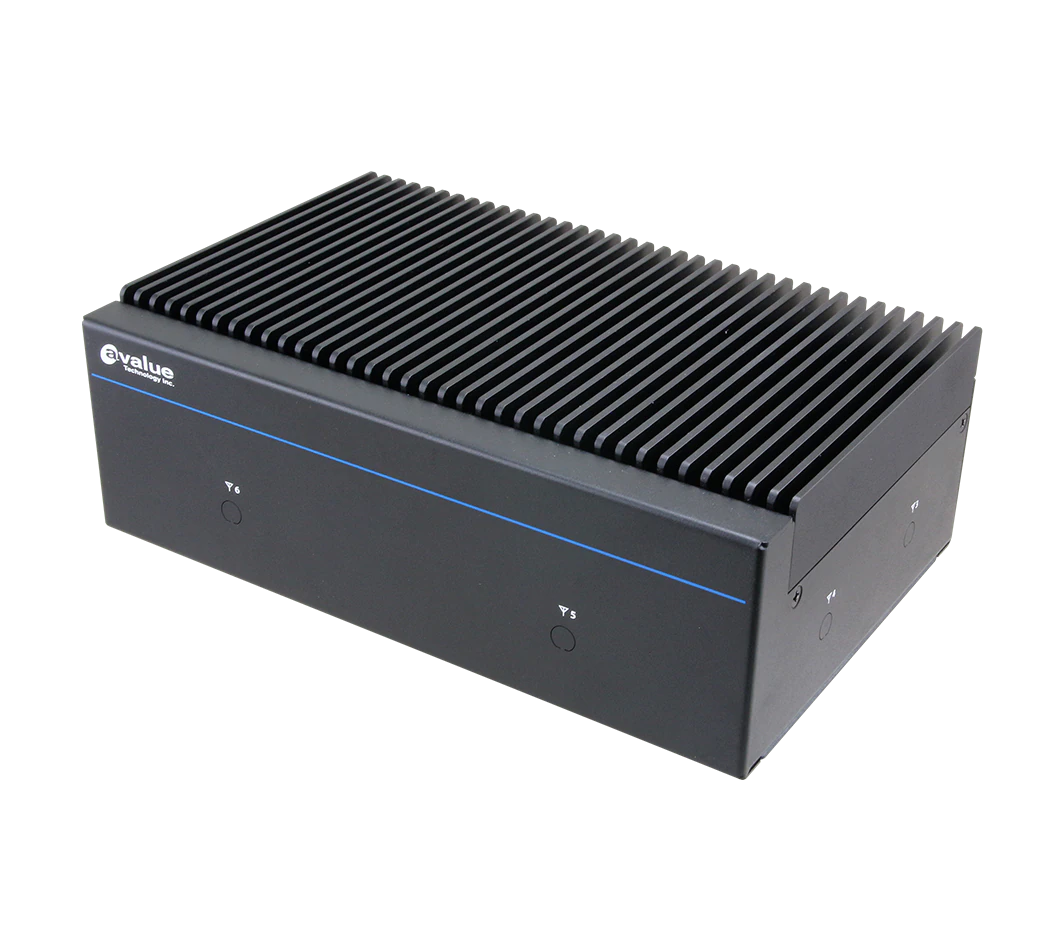
| AIB-NINX-S | Orin NX 8GB/16GB | 70/100 TOPS | 8 internal MIPI CSI-2 lanes, 1 x GbE, 4 x USB 3.2 Gen2; optional PSE board with 4 x IEEE 802.3af ports | 9 to 36 V DC, or 48 V on the PSE model | 0 to 60°C with airflow | Ubuntu 20.04/22.04, JetPack 5.1.1 / 6.2 |
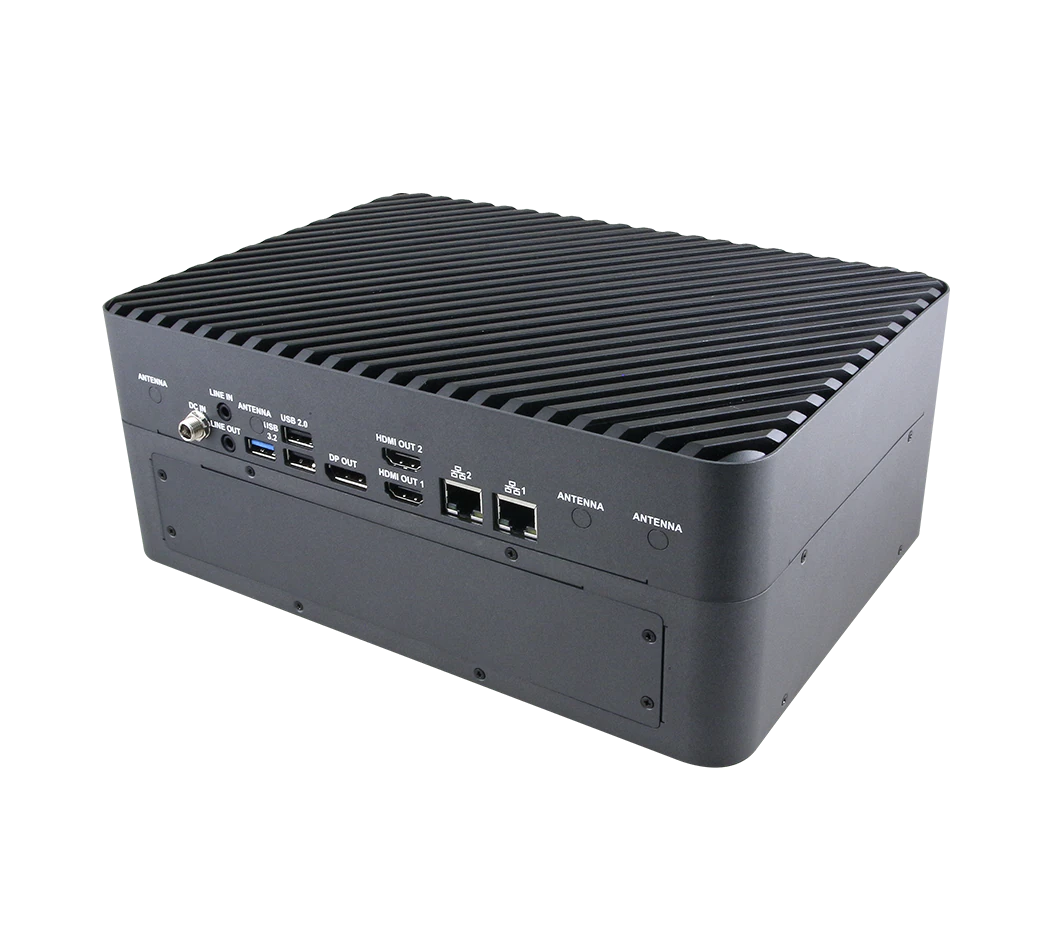
| AIB-NIAO-S | AGX Orin 32GB/64GB | 200/275 TOPS | 16 internal MIPI CSI-2 lanes, 2 x GbE, 2 x PCIe Gen3 x4 slots; optional PSE board with 8 x IEEE 802.3af ports | 12 to 28 V DC | 0 to 60°C with airflow | Ubuntu 20.04/22.04, JetPack 5.1.1 / 6.2 |
How they map to the workloads above:
- AIB-NW01 is the entry point and the only one of the four with a wide low-temperature rating (-15°C). It is offered with either Orin Nano or Orin NX, so one enclosure covers both budgets.
- AIB-NINX-SC is the business-card class box (94.4 x 66 x 69.8 mm on the record), with capture-card variants for non-MIPI cameras.
- AIB-NINX-S is the fanless Orin NX system with more USB and M.2 expansion, and the option of powering up to four 802.3af cameras from the box.
- AIB-NIAO-S is the AGX Orin system for many cameras or heavier models, with PCIe slots for capture cards and an optional eight-port 802.3af PSE board.
For how these boxes sit alongside the camera, lens, lighting and interface, read machine vision system components.
JetPack and long-term availability
JetPack is NVIDIA's software stack for Jetson: the Jetson Linux board support package, CUDA, TensorRT and related libraries. On an industrial box the box maker supplies the board support package for its carrier board, so the JetPack versions you can run are the ones the box maker has released. The Avalue records list JetPack 5.0 (AIB-NW01) and JetPack 5.1.1 or 6.2 (the other three). NVIDIA's JetPack 7.2 release (June 2026) "adds support for the Jetson Orin product family within JetPack 7 releases", on Jetson Linux 39.2 with kernel 6.8 and an Ubuntu 24.04 based root file system (NVIDIA). If you plan to move to JetPack 7, ask whether a board support package for your box is planned before you standardise on it.
Availability is where Jetson Orin is strong for machine builders. NVIDIA's Jetson product lifecycle page lists:
| Module | Available through (NVIDIA) |
|---|---|
| Orin Nano 4GB and 8GB | January 2032 |
| Orin NX 8GB and 16GB | January 2032 |
| AGX Orin 32GB and 64GB | January 2032 |
| AGX Orin Industrial | July 2033 |
The same page says an official end-of-life notice is sent at least 8 months before the last shipment. These dates cover the module; the box built around it has its own lifecycle, so ask for both when you design a machine that will be built for several years.
Newer modules are coming, but they do not shorten Orin's availability. NVIDIA announced Jetson T3000 and T2000 modules in July 2026 for the first quarter of 2027 (NVIDIA blog) and Jetson Orin Nano 2 in August 2026, expected in the first half of 2027 (NVIDIA press release).
How to choose: a short checklist
- Count cameras and their interface (MIPI CSI-2, GigE, USB or capture card).
- Measure your model's frame time and memory use on a development kit; pick the smallest module that meets the cycle time with headroom.
- Choose 16 GB (NX) or 64 GB (AGX) if you expect to add models.
- Confirm the JetPack version, the power mode and the box's thermal rating together; the Super Mode figures need all three.
- Match the operating range and power input to the cabinet, and decide whether cameras will be powered from the box (PoE) or separately.
- Record the module and box lifecycle dates in the bill of materials.
How TSL can help
TSL Automation Solutions, based in Mumbai, has been an authorised Avalue and Cermate distributor since 2015 and ships worldwide. For Jetson Orin projects we supply the Avalue range: AIB-NW01 (Orin Nano or Orin NX), AIB-NINX-SC and AIB-NINX-S (Orin NX), and AIB-NIAO-S (AGX Orin). Use the product finder to narrow the range, or put two systems side by side in the compare tool. With your enquiry, tell us the camera count and interface, the model you plan to run and the JetPack version you need, so the module, I/O and software can be checked against the specification sheets.
Send us the model numbers and quantities and we will reply with availability and lead time within one business day.
Frequently Asked Questions
TSL Automation Solutions
Head of Marketing, TSL Automation Solutions
Sanjana covers industrial automation trends, product launches, and technology insights for TSL Automation Solutions, a Mumbai-based distributor of HMI, Panel PC, and embedded computing systems serving manufacturers across India and globally.
Need help choosing the right product?
Our team in Mumbai can recommend the right HMI, Panel PC, or embedded system for your application.
Contact TSL Automation