Industrial PC and HMI End of Life: How to Plan Replacements
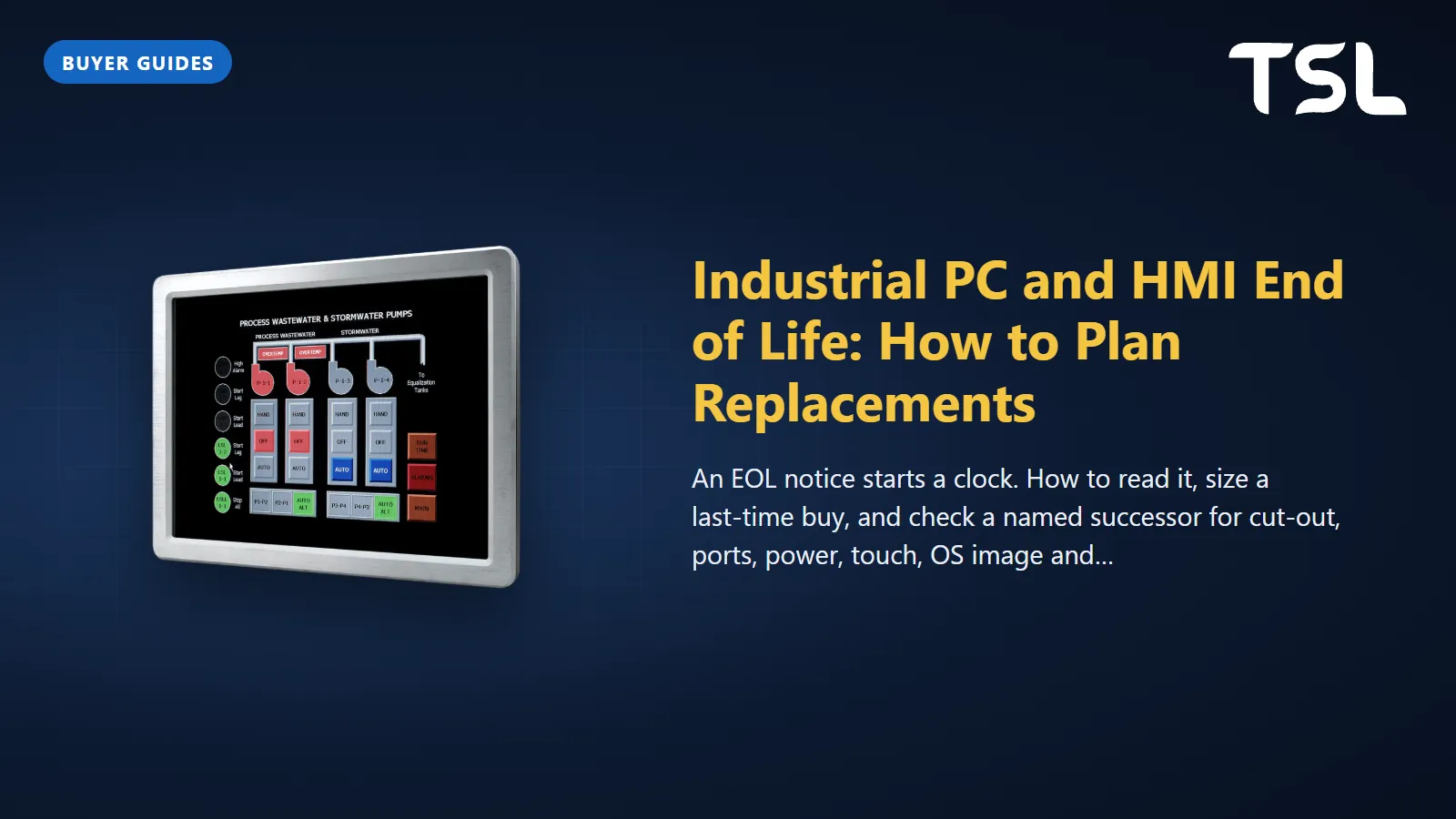
Table of Contents
When an industrial PC or HMI reaches end of life, the plan has three parts: confirm the last order and last ship dates, decide how many units to buy before the door closes (the last-time buy), and qualify a successor against your machine before the old stock runs out. The successor named on a discontinuation notice is rarely a drop-in part. Check the panel cut-out, mounting, ports, power input, touch type, OS image and certifications one by one, because any of them can force a cabinet change or a fresh round of validation.
What an end-of-life notice tells you, and what it leaves out
Suppliers use two kinds of notice. A product change notification (PCN) says that something about a product you can still buy is changing: a component, a BIOS, a manufacturing site. A discontinuation or end-of-life notice says the product itself is going away. Industrial PCs sit downstream of both, because a panel PC is built from processors, chipsets, memory and LCDs that each have their own lifecycle at the chip maker.
At chip level the timelines are published. Texas Instruments, for example, states on its product change notification page that its discontinuance process complies with J-STD-048, that its schedule allows 12 months for the last order, and that the last delivery can come up to six months after the order period ends. Other chip makers publish their own terms, and a board or system builder can only offer its customers whatever window its own component suppliers give it.
So when you receive an EOL notice for a panel PC or box PC, read it for these items and ask for any that are missing:
- Last order date and last ship date, in writing.
- The named successor, and whether it is a direct replacement or only the closest current model.
- Repair support: whether units already in the field can still be repaired, and for how long.
- What happens to the OS image and licence on the successor.
If your organisation wants a formal framework, IEC 62402:2019, Obsolescence management sets out requirements for an obsolescence policy, an obsolescence management plan, design strategies that reduce obsolescence, and the choice of resolution when a part does go away.
How our product pages now flag discontinued Avalue models
Our catalogue currently carries 112 Avalue models marked as discontinued, and 89 of them name at least one successor. Each discontinued product page now shows a notice that Avalue no longer manufactures the model, lists the successor models under "Replaced by", linking to their product pages (or marking a successor "Available on request" where it is not yet listed), and offers an "Ask about stock" button so you can check remaining units and spares. Where no successor is named, the page lists current models in the same range instead. The same "Replaced by" line appears in site search results.
A typical example: the ARC-1209-B, a 12.1" fanless panel PC with an Intel Celeron J1900, is now discontinued, and its page names two successors, the ARC-1239 and the ARC-1242. That is a useful starting point, not the end of the job, as the next section shows.
Form, fit and function: check the successor line by line
Here is what the three spec sheets in our catalogue say, side by side. Every value comes from the product records.
| Check | ARC-1209-B (discontinued) | ARC-1239 (successor) | ARC-1242 (successor) |
|---|---|---|---|
| Display | 12.1" 4:3, 1024x768, 600 cd/m² | 12.1" 4:3, 1024x768, 600 cd/m² | 12.1" 4:3, 1024x768, 600 cd/m² |
| Touch | Projected capacitive, up to 10 points | 5-wire resistive | 5-wire resistive |
| Processor | Intel Celeron J1900 | Intel N97, Amston Lake X7433RE or Twin Lake N150 | 13th Gen Intel Core 3/5/7 (Raptor Lake-PS) |
| Dimensions (W x L x H) | 292.86 x 225.4 x 51.5 mm | 283 x 222 x 47.7 mm | 283 x 222.1 x 51.2 mm |
| Mounting kits listed | Wall, stand, VESA 75/100, panel mount | Wall, stand, VESA 75/100 | Wall, stand, VESA 75/100, panel mount |
| Serial ports | 1 x RS-232/422/485, 1 x RS-232 | 1 x RS-232/422/485, 1 x RS-232 | 1 x RS-232/422/485 |
| LAN | 2 x Gigabit (Intel I211AT) | 2 x 2.5GbE (Intel I226IT) | 2 x 2.5GbE (Intel I225LM, I226LM) |
| DC input | +12V to +26V | +12V to +24V | +12V to +24V |
| Operating temperature | -10°C to 50°C | -20°C to 60°C | -10°C to 50°C |
| OS listed | Win 7 / 10 / Linux / Android 8.1 | Win10 / Win11 / Linux | Win10 / Win11 / Linux |
| Certifications listed | CE, FCC Class B | CE / FCC Class B / UKCA | CE / FCC Class A / VCCI |
Both successors keep the screen size, resolution and brightness, which protects your HMI screen layouts. But look at what changes:
- Touch technology. The old unit is projected capacitive; both successors are 5-wire resistive. Operators will feel the difference, and multi-touch gestures will stop working. For background, see our guide to touch screen technologies for industrial HMIs.
- Cut-out and mounting. The outer dimensions differ by several millimetres, and the ARC-1239 record does not list a panel-mount kit. The catalogue does not publish panel cut-out sizes for these models, so ask for the mechanical drawing of the successor and compare it with your cabinet door before ordering.
- Ports. The ARC-1242 has one serial port where the ARC-1209-B had two. If a barcode reader and a PLC both hang off COM ports, that matters.
- Power. Both successors top out at 24V. A 24V DC supply is fine; anything that relied on the 26V headroom is not.
- Certifications. Under the FCC rules in 47 CFR 15.3, a Class A digital device is one marketed for commercial, industrial or business environments, and a Class B device is one marketed for residential use. If your machine's paperwork relies on the PC being Class B, the ARC-1242 changes that.
- OS image. Your old image will not simply move across. More on this below.
Three more pairs from the catalogue
| Discontinued | Named successor | What changes, per the spec sheets |
|---|---|---|
| ARC-1538-C1 (15" 4:3) | ARC-1542 | Width and length match (350.51 x 274.51 mm) but depth drops from 65 to 54.5 mm; DC connector changes from Mini-DIN 4-pin to a lockable DC jack; touch changes from projected capacitive (resistive optional) to 5-wire resistive; serial ports go from three to one. |
| FPC-1736 (17" 4:3, 1280x1024) | FPC-21W42 | Screen grows to 21.5" 16:9, 1920x1080, and the width to 538 mm, so the cabinet opening and every HMI screen need redesign; OS list adds Win11 and TPM 2.0 is listed. |
| EPC-SKLU (6th Gen Core box PC) | EPC-RPU | Footprint is close (177 x 123 x 50 mm to 177 x 126 x 57 mm); listed mounting changes from stand, with VESA and DIN rail as factory options, to a wall-mount kit; both serial ports become RS-232/422/485; OS list moves from Win 7/8/10 to Win10/Win11. |
None of these are faults in the successors. They are what happens when a product is redesigned around newer silicon. The point is to find them on paper, before a technician finds them on site.
The OS image is part of the fit
A discontinuation is often the moment a machine has to move to a newer Windows release, because the successor's processor may not be supported by the old one, and the old one may itself be out of support. The ARC-1209-B, for instance, lists Windows 7 and 10; its J1900 processor family is not among the Intel platforms on Microsoft's supported processor list for Windows 11 IoT Enterprise LTSC 2024, while the platforms used in the ARC-1239 and ARC-1242 are. Microsoft's Windows IoT Enterprise overview also notes that upgrading from one LTSC version to the next requires a new licence, and it tells device makers to make sure they have a long-term supply of hardware for the expected life of their devices. If your fleet still runs Windows 10 IoT LTSB 2016, read our note on Windows 10 IoT end of support before you plan the image.
HMIs: cut-out compatibility and project portability
Operator panels raise the same questions, with the panel cut-out usually the hardest constraint. This is where published cut-out dimensions help. Our Cermate HMI records list them: several other 7" Cermate panels in our catalogue, such as the IPT2070-51ST, use a 191.5 x 138 mm cut-out, while the IPT2070-WST4B uses 175 x 132.5 mm and its spec sheet states that the cut-out is compatible with the Cermate PT070. That lets a PT070 site change the panel without cutting the door. The same record notes that a PM Designer application can be switched to a different LCD size, which shortens the project side of a migration. Our PM Designer guide covers the software side, and we have a separate note on the PT070 factory reset without an SD card.
How to size a last-time buy
A last-time buy (LTB) is a bet on how many units you will need between the last order date and the day your successor is fully validated and in production. Build the number from four parts:
- Production demand: machines you will build with this PC until the successor is approved. Be honest about how long validation takes; it is usually longer than the plan says.
- Field replacements: units you expect to swap in the installed base over the support period you have promised customers. Use your own RMA and service history, not a datasheet MTBF figure.
- Repair pool: a few units to swap immediately while failed ones are diagnosed.
- A margin for the unexpected, such as a large order or a site that standardises on your machine.
An illustrative example, with made-up numbers: you build 40 machines a year, expect 12 months to qualify the successor, have 250 machines in the field with a five-year service commitment, and your service records show about 2 PC swaps per 100 machines per year. That gives 40 for production, 25 for field replacements (250 x 2% x 5), 5 for the repair pool and perhaps 10 as margin: 80 units. Then weigh the cash tied up against the cost of an unplanned redesign. Our industrial PC total cost of ownership guide is a useful companion for that comparison.
Keeping spares that still work years later
- Store them as the spec sheet says. The ARC-1209-B record gives a storage temperature range of -20°C to 60°C; keep spares within that range, in a dry store and in their original packaging.
- Keep the golden image with the hardware. Store the tested OS image, BIOS settings, drivers and licence details with the spares, labelled by hardware revision.
- Power them up periodically and run your acceptance test, so a dead unit is found in the store, not on a stopped line.
- Record serial numbers and revisions, so a field swap uses a unit that matches the image.
A replacement plan in six steps
- List every installed PC and HMI by model, quantity, site and the application it runs.
- Check each model's product page for a "Discontinued" notice and the named successor.
- Ask for last order and last ship dates in writing, then place the last-time buy.
- Compare the successor's spec sheet and mechanical drawing against the checks above.
- Build the new OS image and HMI project on one unit and run your factory acceptance test.
- Update drawings, manuals and the spare parts list, then switch production.
How TSL can help
TSL Automation Solutions in Mumbai has been an authorised Avalue and Cermate distributor since 2015 and ships worldwide. For discontinued Avalue ARC, FPC and EPC models we can check remaining stock and quote the named successors; for Cermate HMIs we can quote panels by cut-out size. If you are choosing afresh, narrow the list in the product finder and put candidates side by side in the compare tool.
Send us the model numbers and quantities and we will reply with availability and lead time within one business day.
Frequently Asked Questions
TSL Automation Solutions
Head of Marketing, TSL Automation Solutions
Sanjana covers industrial automation trends, product launches, and technology insights for TSL Automation Solutions, a Mumbai-based distributor of HMI, Panel PC, and embedded computing systems serving manufacturers across India and globally.
Need help choosing the right product?
Our team in Mumbai can recommend the right HMI, Panel PC, or embedded system for your application.
Contact TSL Automation