What Is an Industrial IoT Gateway? The Bridge Between Your Factory Floor and the Cloud
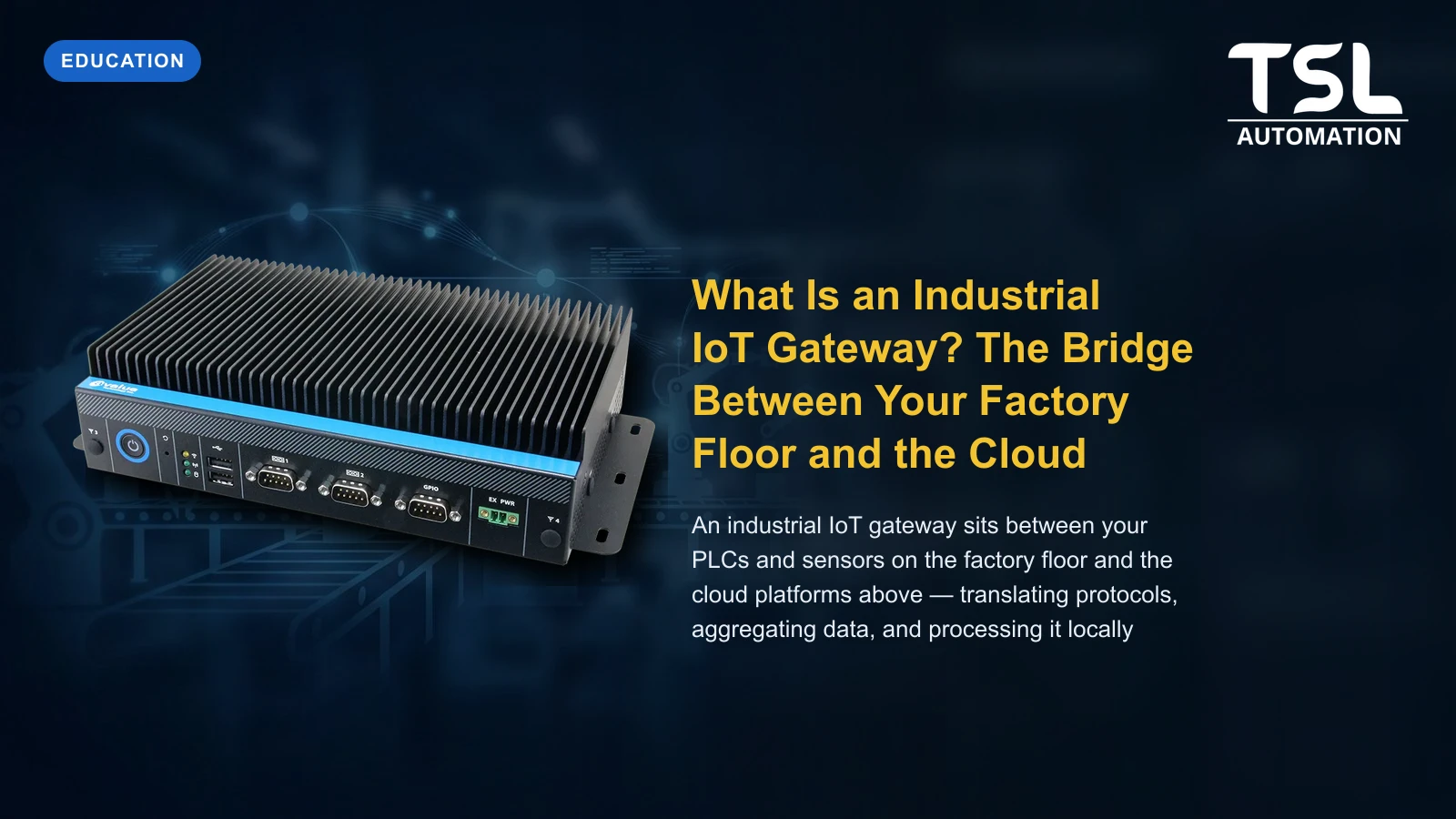
Table of Contents
What Does an Industrial IoT Gateway Do?
An industrial IoT (IIoT) gateway is a hardware device that sits between the operational technology (OT) layer — your PLCs, sensors, drives, and HMIs — and the information technology (IT) layer — your cloud platform, MES, ERP, or data analytics system. Its primary jobs are:
- Protocol translation — converting Modbus RTU, PROFIBUS, EtherNet/IP, and other industrial protocols into MQTT, REST/HTTP, or OPC UA that cloud platforms understand
- Data aggregation — collecting data from tens or hundreds of field devices and consolidating it into a single data stream
- Edge processing — filtering, compressing, and pre-processing data locally to reduce bandwidth and cloud processing costs
- Security enforcement — acting as a firewall between the OT network and the IT/cloud network
- Store-and-forward — buffering data locally when the internet connection drops, then forwarding it when connectivity resumes
Key Components of an IIoT Gateway
A complete IIoT gateway solution consists of three layers:
- Hardware — a rugged embedded PC with multiple COM ports, dual LAN, and often a 4G modem. DIN rail form factor for easy cabinet mounting.
- Protocol drivers — software drivers that speak the field device protocols (Modbus, PROFIBUS, BACnet, EtherNet/IP, OPC DA/UA)
- Gateway software — the platform that manages protocol translation, data routing, and cloud connectivity
Popular Gateway Software Platforms
| Platform | Type | Best For |
|---|---|---|
| Node-RED | Open-source, visual flow editor | Custom integrations, rapid prototyping, Modbus to MQTT |
| Ignition Edge | Commercial (Inductive Automation) | SCADA edge node, OPC UA server at the edge |
| AWS IoT Greengrass | Amazon cloud extension | AWS-centric deployments, local Lambda functions |
| Azure IoT Edge | Microsoft cloud extension | Azure-centric deployments, container-based modules |
| Kepware | Commercial (PTC) | Industrial protocol aggregation, OPC UA server |
| MQTT Broker (Mosquitto) | Open-source | Lightweight MQTT brokering at the edge |
Hardware Requirements for an IIoT Gateway
The gateway hardware must be reliable, compact, and able to handle multiple communication interfaces simultaneously. Key requirements include:
- DIN rail mounting — for easy installation inside existing control cabinets
- Multiple COM ports — RS-232/422/485 for legacy field devices
- Dual LAN ports — one for the OT network (PLC side), one for the IT/WAN side
- 4G/LTE modem slot — for remote sites without fixed internet
- Wide temperature range — control cabinets can reach 50–60°C
- Fanless design — no maintenance in sealed cabinets
- Sufficient RAM and storage — for gateway software and local data buffering
Avalue DIN Rail PCs as IIoT Gateways
Avalue Technology's DIN rail embedded PCs are purpose-built for the IIoT gateway role. They combine a fanless embedded processor, multiple serial ports, dual Gigabit LAN, optional 4G modem, and wide temperature operation in a compact DIN rail chassis that fits directly into existing control cabinets. Running Windows IoT or Linux, they support all major gateway software platforms including Node-RED, Ignition Edge, and Azure IoT Edge.
TSL Automation Solutions supplies Avalue DIN rail PCs across India with full technical support for gateway deployments. Contact us to discuss your IIoT gateway project.
Frequently Asked Questions
TSL Automation Solutions
Head of Marketing, TSL Automation Solutions
Sanjana covers industrial automation trends, product launches, and technology insights for TSL Automation Solutions, a Mumbai-based distributor of HMI, Panel PC, and embedded computing systems serving manufacturers across India and globally.
Need help choosing the right product?
Our team in Mumbai can recommend the right HMI, Panel PC, or embedded system for your application.
Contact TSL Automation