
Section 6.3.4 · Chapter 6: Lamps
Message Display - General Settings
This section describes how to define the general settings for a message display. The following is an example of the General page of the Message Display property sheet.
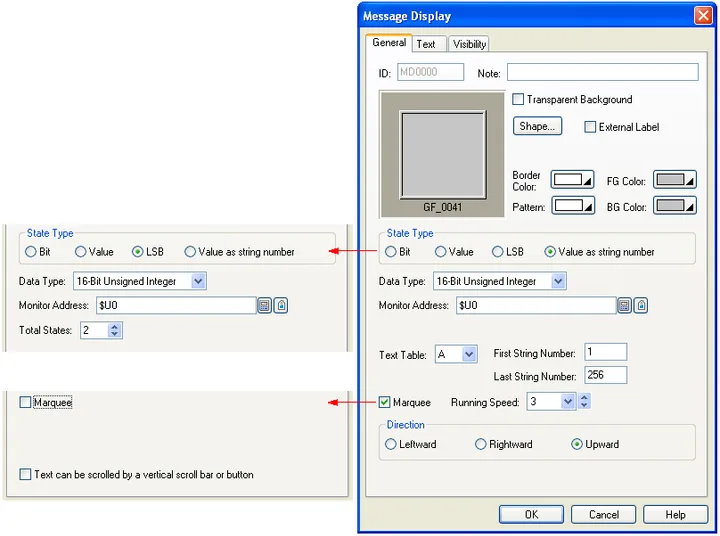
The following table describes each property in the General page.
|
Property |
Description | |
|---|---|---|
| ID | The object’s identifier. It is generated when the object is created. The identifier is unique within the screen where the object is located. The format of the IDs for the message displays is MDnnnn. | |
| Note | You can type a note for the object. | |
| Transparent Background | Select this option if you want the object to have a transparent background. | |
| Shape settings |
For details about the following properties,
Section 4.3.4 Setting up the Shape
of an Object.
 ,
Border Color, Pattern, FG Color, BG Color |
|
| External Label | Check this option if you want the message display to have an external label. Set up the external label in the External Label page. | |
| State | Select a state as the current state of the message display so you can view and set the Pattern, FG Color, BG Color for that state. | |
| State Type | The state type of the variable that controls the message display. The supported state types include Bit, Value, LSB and Value as string number. For details, see Section 6.3.1 Basic Operations. | |
| Data Type | The data type of the variable that controls the message display. The supported data types include: Bit, 16-bit Unsigned Integer, 16-bit Signed Integer, 16-bit BCD, 32-bit Unsigned Integer, 32-bit Signed Integer, and 32-bit BCD. | |
| Monitor Address |
Specifies the variable that controls the message
display. Click  to enter an address for this field. Click  to select a tag for this field. |
|
| Total States | Specifies the number of states of the message display if the state type is Bit, Value or LSB. | |
| Text Table | Text Table | Select a text table with messages for the object if the state type is Value as string number. |
| First String Number | Specifies the first string number from 1 to 20000. | |
| Last String Number | Specifies the last string number from 1 to 20000. | |
| Marquee | Marquee |
Select this item if you want the displayed message to
scroll automatically. |
| Running Speed | The speed of scrolling. Select from 1 to 10, 1 being the slowest and 10 being the fastest. | |
| Direction | The direction of scrolling. The supported directions include Leftward, Rightward, and Upward. | |
| Text can be scrolled by the vertical scroll bar or button | Select this option so you can scroll the content of the message display vertically using the associated scroll buttons or scroll bar. | |
Need PM Designer itself?
V4 for current PK, PT, ITV and PM panels, V2 for older models. Free, sent by email.
Source.Section 6.3.4 of the PM Designer Software User Manual, Edition 2.0, © Cermate Technologies Inc. (www.cermate.com, service@cermate.com). Reproduced online, with the manual's own figures, by TSL Automation Solutions, authorised Cermate distributor, for users of Cermate HMI panels. PM Designer and PanelMaster are trademarks of Cermate Technologies Inc.
Text and figures are the manufacturer's and may describe features your panel or software version does not have. For a plain-language introduction read the PM Designer guide; for help with a specific panel contact TSL Automation.