Medical Cart Accessories: Arms, Batteries and Stands for Clinical PCs
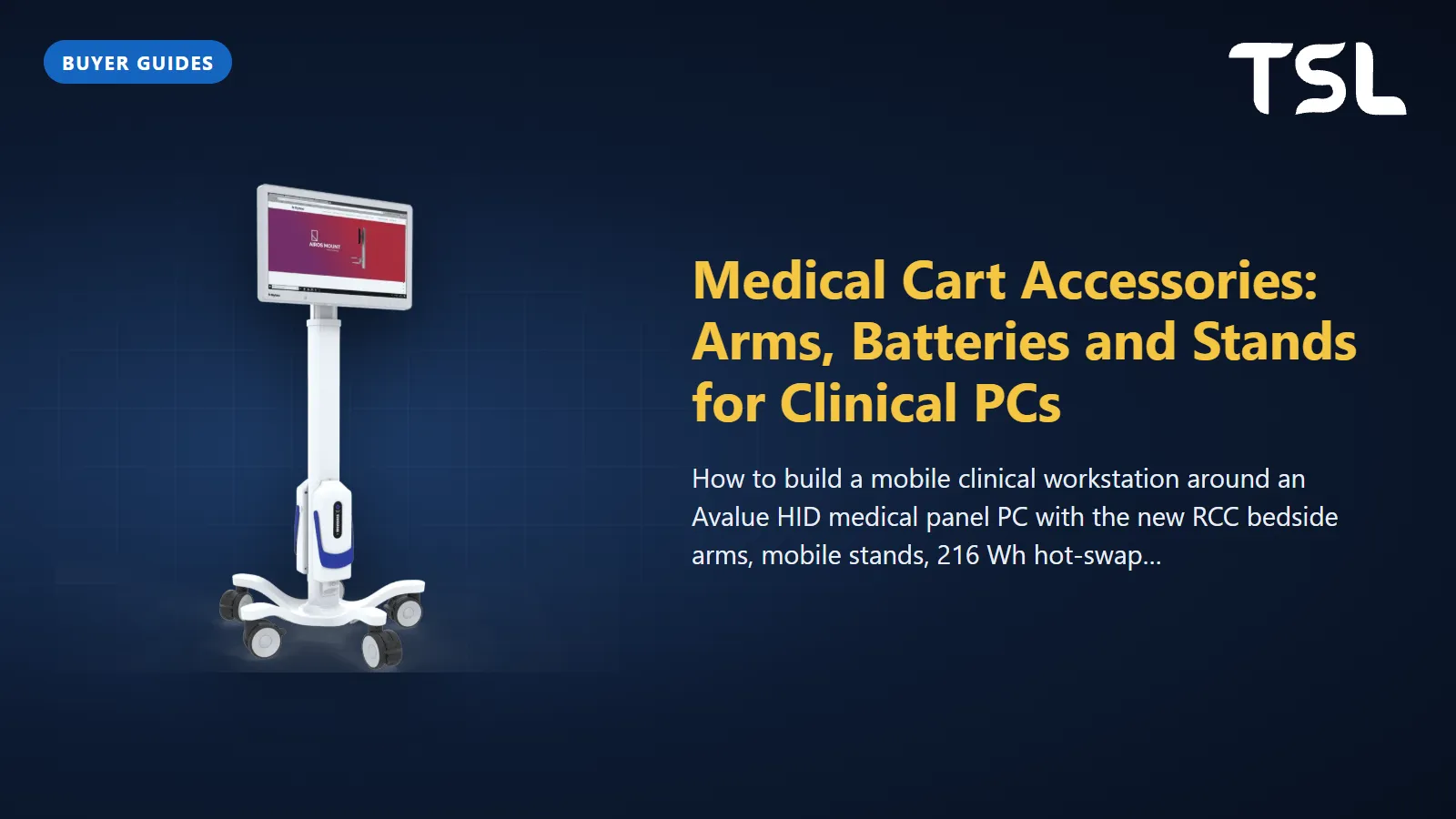
Table of Contents
A medical cart workstation is three parts that have to agree with each other: a medical panel PC, something to carry it (a cart, a mobile stand or a bedside arm) and a power system that keeps it running away from the wall. Avalue's ten new RCC accessories cover the last two: two bedside monitor arms, three mobile stands, two Power-on-Pole units, a 216 Wh hot-swap battery module and two wall bay chargers. Size them in this order: panel PC weight and DC input, then the carrier's load rating, then battery capacity against a measured shift load.
The ten new RCC accessories at a glance
These are now listed on our site alongside the carts covered in our medical cart buyer guide. All specifications below come from the product records.
| Model | Type | Key specifications |
|---|---|---|
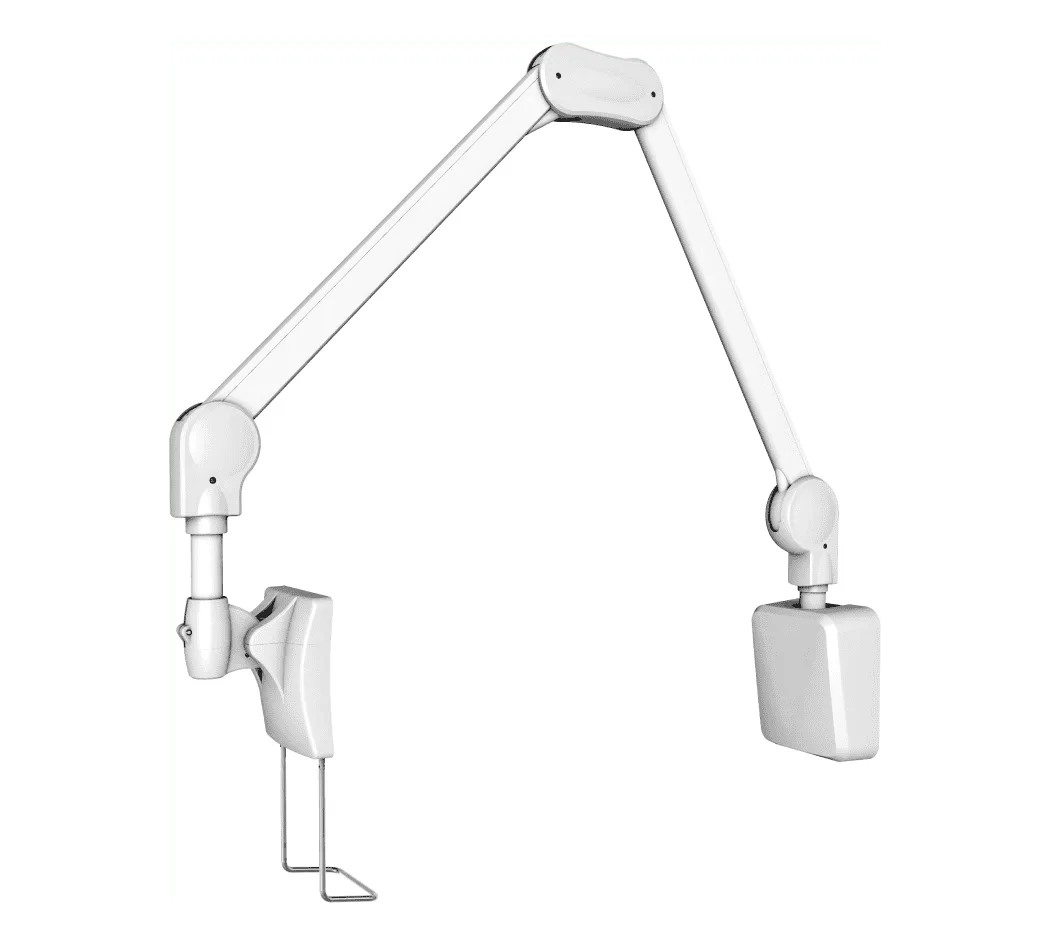
| RCC-ARM-HGD-01R | Bedside monitor arm | One 15 to 24 inch display, 1 to 8 kg, VESA 75 or 100, 1467 mm height adjust range, hinge swivel +/-185°, tilt -60° to +20° |
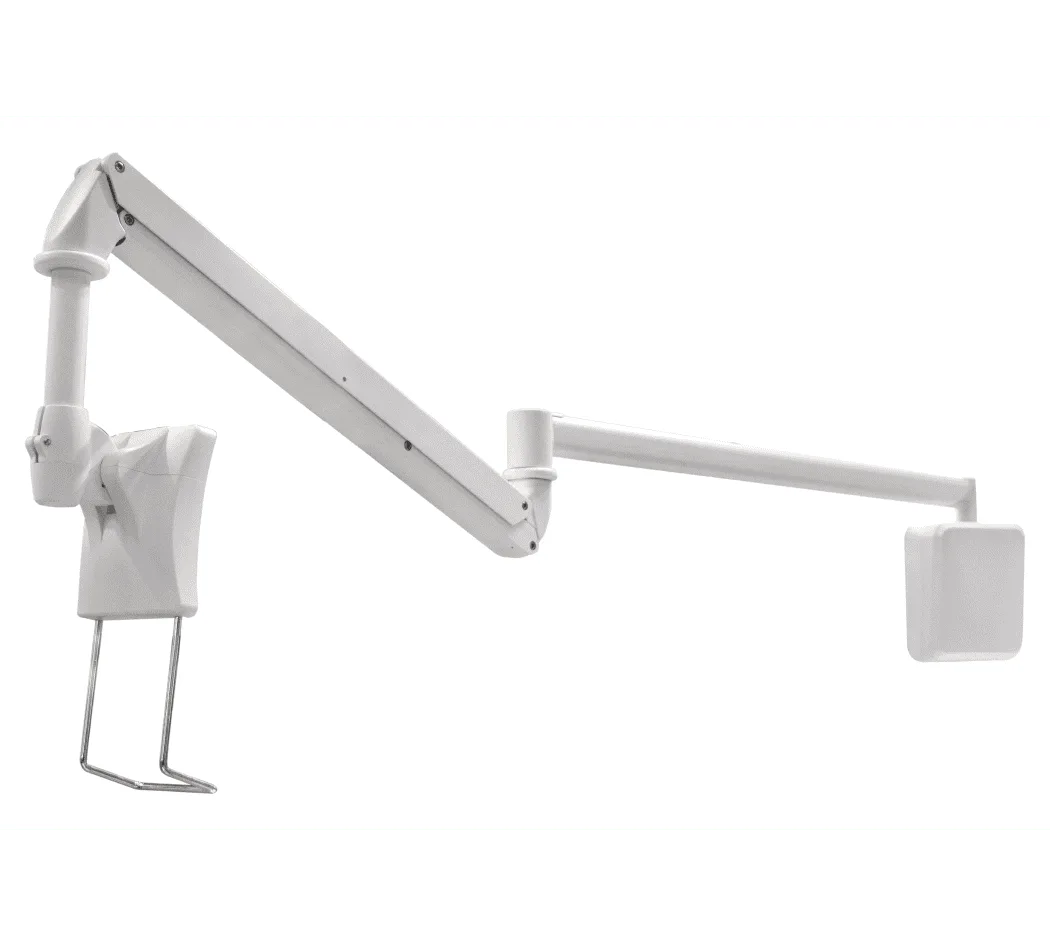
| RCC-ARM-HGD-02R | Bedside monitor arm | One 15 to 24 inch display, 6 to 12 kg, VESA 75 or 100, 890 mm height adjust range, user torque adjust on the hinge |
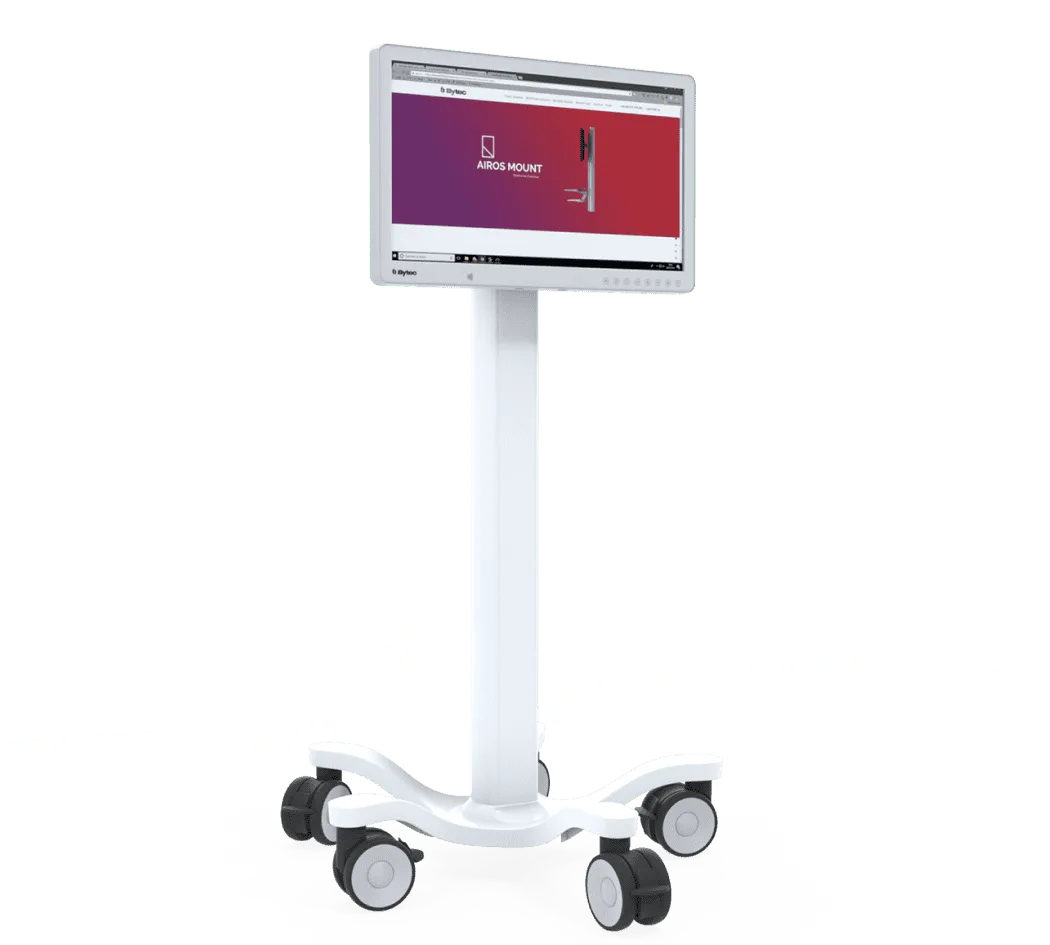
| RCC-ECOSTAND-02R | Height-adjustable mobile stand | 1185 to 1585 mm (400 mm travel), five braked 75 mm castors, Power-on-Pole single or dual dock, CE and UKCA |
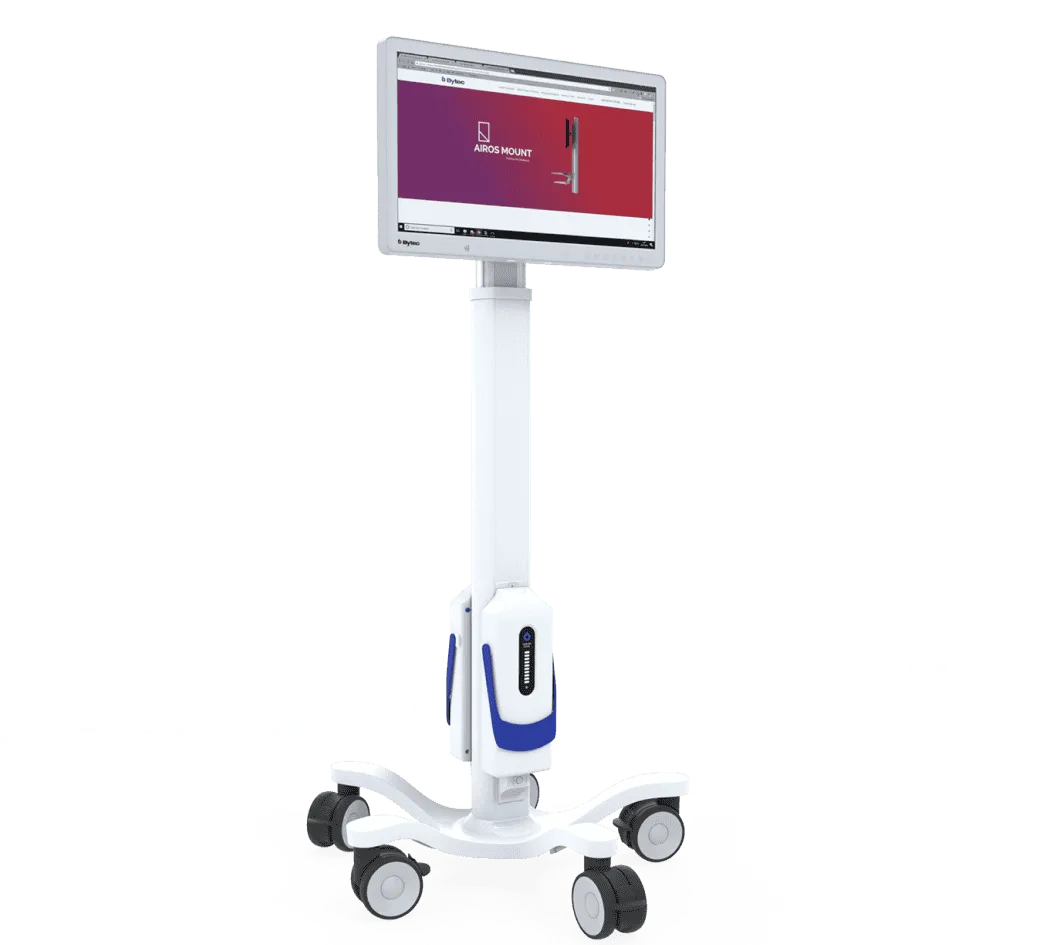
| RCC-GENISTAND-01R | Height-adjustable mobile stand | 1155 to 1555 mm (400 mm travel), 675 mm base, braked 100 mm castors, Geni-Tec single or dual dock |
| RCC-MEDISTAND-01R | Fixed-height mobile stand | 1250 mm standard, 12 kg maximum mount weight, 18 kg maximum carrying load (subject to height), 4 or 5 wheel base |
| RCC-POP-01R | Power-on-Pole, single module | 28 VDC in, 12 to 28 VDC out, 150 W maximum at 19 to 28 VDC, 216 Wh, 50 mm pole version |
| RCC-POP-03R | Power-on-Pole, two modules | 28 VDC in, 12 to 28 VDC out, 100 W maximum at 12 to 18 VDC, 432 Wh with two modules |
| RCC-BAT-GENI-01R | Hot-swap battery module | 21.6 V, 216 Wh, 10 Ah polymer lithium-ion, IP67, 2.5 h typical recharge at 4 A, 2 kg |
| RCC-BAT-GENI-02R | Wall bay charger, mains | 90 to 264 VAC input, internal medical grade supply (Class I), 3.75 A per bay, 2.75 h typical recharge, IEC 60601-1 |
| RCC-BAT-GENI-03R | Wall bay charger, DC | 28 VDC from an external supply, 7.0 A maximum input, 3.75 A per bay, 2.75 h typical recharge, 2.05 kg |
Step 1: start from the medical panel PC
Every other choice follows from the computer, because its weight sets the mount and its DC input and adapter rating set the power system. Avalue's HID medical panel PCs all have a projective capacitive touchscreen and a front panel rated IP65. The HID-1540, HID-2138 and HID-2340 list VESA 75 and 100 mounting, which matches the arms, stands and carts above; the HID-2146 record does not yet give its VESA pattern, so confirm it with us.
| Panel PC | Screen | Weight | DC input | Supplied adapter | Ingress rating |
|---|---|---|---|---|---|
| HID-1540 | 15.6", 12th Gen Intel Core | 2.8 kg | 19 V, lockable jack | 90 W medical grade | Front IP65, back IPX1 |
| HID-2138 | 21.5", 11th Gen Intel Core | 4.5 kg | 19 V, lockable jack | 90 W medical grade | Front IP65 |
| HID-2340 | 23.8", 12th/13th Gen Intel Core | 6 kg | 24 V, lockable jack | Medical 24 V adapter | Front IP65, back IP54 |
| HID-2146 (coming soon) | 21.5", Intel Core Ultra 5 225U or Ultra 7 255U | 5.4 kg | 24 V, lockable jack | 180 W medical grade | Front IP65, back IP54 |
On certification, the HID-2340 lists medical CE to IEC/EN 60601-1 (safety) and IEC/EN 60601-1-2 (EMC) plus UL to AAMI ES60601-1, and the HID-2146 lists IEC/EN 60601-1 and 60601-1-2 with UL and cUL. If you are not sure what the difference between "certified" and "compliant" means for your tender, read our IEC 60601-1 buyer guide, and our medical panel PC buying guide covers screen size, I/O and isolation options.
Step 2: choose the carrier (cart, stand or bedside arm)
Bedside arms for fixed positions
The two HGD arms are listed in Avalue's ordering information as bedside arms that include a wall box, so they suit a bed bay, an ICU position or a nursing station where the screen should swing to the patient and back again, rather than a cart that moves between rooms. Match the arm to the panel weight, plus anything you hang on it:
- RCC-ARM-HGD-01R carries 1 to 8 kg. The HID-1540 (2.8 kg), HID-2138 (4.5 kg) and HID-2146 (5.4 kg) all sit inside that range.
- RCC-ARM-HGD-02R carries 6 to 12 kg. The HID-2340 at 6 kg sits at the bottom of that range; anything lighter falls outside the arm's rating, so use the 01R instead.
Both arms take displays from 15 to 24 inch, adjust tension torque, swivel +/-185° at the hinge and tilt from -60° to +20°, and have built-in cable management.
Mobile stands for rounds and point of care
A stand is the lighter, narrower alternative to a full cart: a pole, a base and castors, with the panel PC and power system on the pole. All three new stands quote a 10° static tilt test as per EN 60601-1 section 9.4.2.1, which is the stability check you want for a tall, top-heavy load.
- RCC-MEDISTAND-01R: fixed height at 1250 mm as standard, 12 kg maximum on the mount and 18 kg total carrying load, which comfortably covers any HID panel PC. Choose the 5 wheel 675 mm base for stability or the 4 wheel 561 x 557 mm base for tight bays. It is power ready for the Geni-Tec system.
- RCC-GENISTAND-01R: 400 mm of height adjustment (1155 to 1555 mm) for staff who stand to chart, on a 675 mm base with braked 100 mm castors and single or dual dock Geni-Tec power.
- RCC-ECOSTAND-02R: also 400 mm of travel (1185 to 1585 mm) on five braked 75 mm castors and a small footprint, compatible with the Power-on-Pole system in single or dual dock form.
Accessories across the stands include a handle, basket, Medi-Rail, cable hook, drip pole, PSU adapter holder and keyboard tray. If clinicians need a writing surface, a key-locked compartment or drawers, the RCC-CAR-HGD-02R cart (displays up to 27 inch, 2 to 8 kg on the display mount, optional drawer kits) is the better base. If the priority is battery power on a cart, the RCC-GENICART-02R has a dual dock Geni-Tec system built in and adjusts from 810 to 1110 mm.
Step 3: power and battery runtime
The power system has three pieces. The RCC-BAT-GENI-01R is the battery itself: a 216 Wh, 21.6 V polymer lithium-ion module that snaps in and out, can be hot swapped while the equipment keeps running, shows its charge on a 10 segment LED bar and is rated for a minimum of 1000 cycles. Its listed compliance covers UKCA, CE and UN38.3, with IEC 62133 and UL 2054 for the internal cell pack. The Power-on-Pole unit holds the modules on the stand and converts their output to the voltage your panel PC needs. The bay charger on the wall recharges spare modules.
Match voltage and wattage first
Both POP units take 28 VDC in and give 12 to 28 VDC out, a range that covers the 19 V input of the HID-1540 and HID-2138 and the 24 V input of the HID-2340 and HID-2146; confirm the output setting for your panel PC with us. Wattage is where to be careful:
- The RCC-POP-01R is rated 150 W maximum at 19 to 28 VDC, which is the band the HID panel PCs use. It holds one 216 Wh module.
- The RCC-POP-03R holds two modules for 432 Wh, but its record gives its 100 W maximum at 12 to 18 VDC only. Ask us to confirm its rating at 19 or 24 V before you pair it with an HID panel PC.
- The HID-2146 ships with a 180 W adapter. An adapter rating is a ceiling, not the running load, but confirm the panel PC's peak draw against the POP rating with us before you commit.
Estimate runtime from measured load, not the adapter label
Runtime in hours is roughly the battery energy in watt-hours divided by the average load in watts, less conversion losses in the Power-on-Pole. The adapter rating (90 W on the HID-2138, for example) tells you the worst case, not what the panel PC draws while showing a charting screen. Measure the real draw with a DC power meter over a typical hour, including the barcode scanner and any other USB devices.
As a worked example only: if your panel PC and scanner together average 40 W, one 216 Wh module gives about 216 / 40 = 5.4 hours before conversion losses, and two modules (432 Wh) about 10.8 hours. Replace the 40 W with your own measured figure. Because the modules hot swap, a shift does not have to fit inside one battery: a spare module charging on the wall can go in when the first runs low, and a typical recharge takes 2.5 to 2.75 hours. Work out how many spares you need from your measured runtime and shift pattern.
Where to charge
The RCC-BAT-GENI-02R runs straight from the mains (90 to 264 VAC, 47 to 63 Hz) through an internal medical grade Class I supply and is listed to EN/ES/IEC 60601-1. The RCC-BAT-GENI-03R is the lighter 2.05 kg version that takes 28 VDC from an external supply. Both charge at up to 3.75 A per bay with a smart multi-chemistry method and mount on the wall, which keeps charging off the floor and out of the cleaning path.
Step 4: hygiene and cleaning
The CDC's guideline classes computers as noncritical patient-care items, meaning they touch intact skin only, and calls for low-level disinfection for noncritical items (CDC, A Rational Approach to Disinfection and Sterilization). In practice that means the whole workstation gets wiped down often, so every part should tolerate it:
- Panel PC: the HID front panels are IP65 and described as antimicrobial (the HID-2146 lists an antimicrobial housing); the HID-2340 and HID-2146 are also rated IP54 at the back.
- Battery: the RCC-BAT-GENI-01R is IP67, which the record links to easy antibacterial cleaning.
- Stand: the MediStand has moulding without seams and integrated cable management, and the EcoStand is described as easy to clean for infection control.
- Cables: use the cable management built into the arms, stands and carts. Loose cable loops collect dust and get missed by the wipe.
Check each disinfectant against the cleaning instructions in the panel PC and accessory manuals and against your hospital's infection control SOP before rollout. We do not state disinfectant compatibility here because it depends on the agent.
Example builds
| Use case | Panel PC | Carrier | Power |
|---|---|---|---|
| Bedside charting, fixed bed bay | HID-2138 (4.5 kg) | RCC-ARM-HGD-01R | Mains through the medical adapter |
| Ward rounds, EMR at the bedside | HID-1540 or HID-2138 | RCC-GENISTAND-01R | RCC-POP-01R with RCC-BAT-GENI-01R modules, RCC-BAT-GENI-02R on the wall |
| Larger screen, nursing station or ICU bay | HID-2340 (6 kg) | RCC-ARM-HGD-02R | Mains through the medical adapter |
| Battery-powered cart with keyboard tray | HID-2138 or HID-2340 | RCC-GENICART-02R | Dual dock Geni-Tec with RCC-BAT-GENI-01R modules (supplied separately) |
These are starting points. Send us the panel PC, peripherals and shift pattern and we will check the weights, voltages and wattages against the records before you order.
How TSL can help
TSL Automation Solutions has been an authorised Avalue distributor since 2015, based in Mumbai and shipping worldwide. We supply the HID medical panel PCs together with the RCC arms, stands, carts, Power-on-Pole units, battery modules and bay chargers, so the whole workstation can come on one quote. Use the compare tool to put the HID models side by side.
Send us the model numbers and quantities and we will reply with availability and lead time within one business day.
Frequently Asked Questions
TSL Automation Solutions
Head of Marketing, TSL Automation Solutions
Sanjana covers industrial automation trends, product launches, and technology insights for TSL Automation Solutions, a Mumbai-based distributor of HMI, Panel PC, and embedded computing systems serving manufacturers across India and globally.
Need help choosing the right product?
Our team in Mumbai can recommend the right HMI, Panel PC, or embedded system for your application.
Contact TSL Automation